Buying guide
How to Choose an Alarm Clock That Fits the Sleeper
The best alarm clock is not the model with the longest feature list. It is the one whose signal, controls, and failure behavior fit the morning that must work.
The decision first
Which three requirements cannot be compromised?
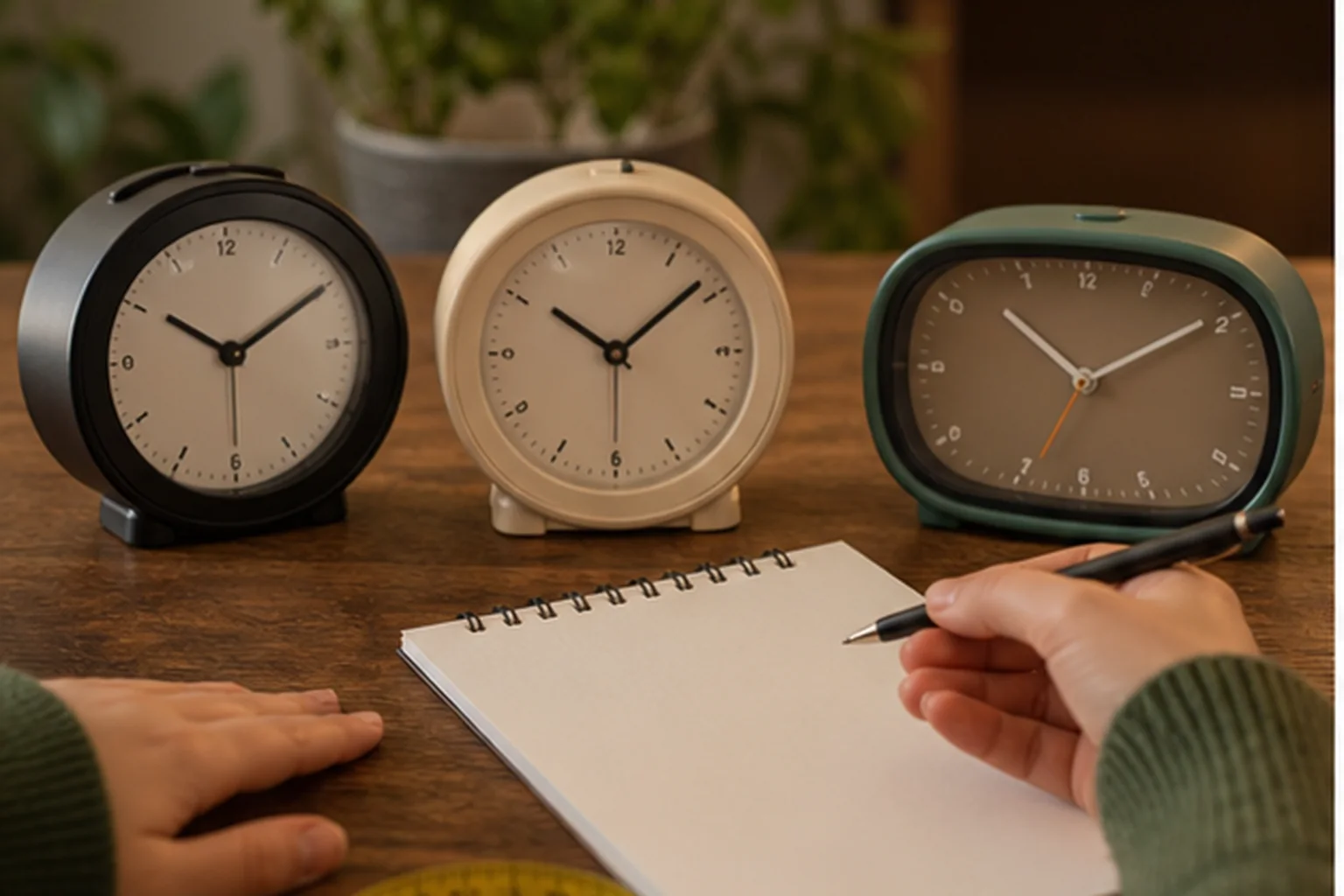
Choose in this order: signal, sleeper, room, power, controls, and optional extras. Eliminate models that fail a nonnegotiable requirement before comparing radio, charging, sounds, or design. Verify the surviving model in the current manual and test the complete routine.
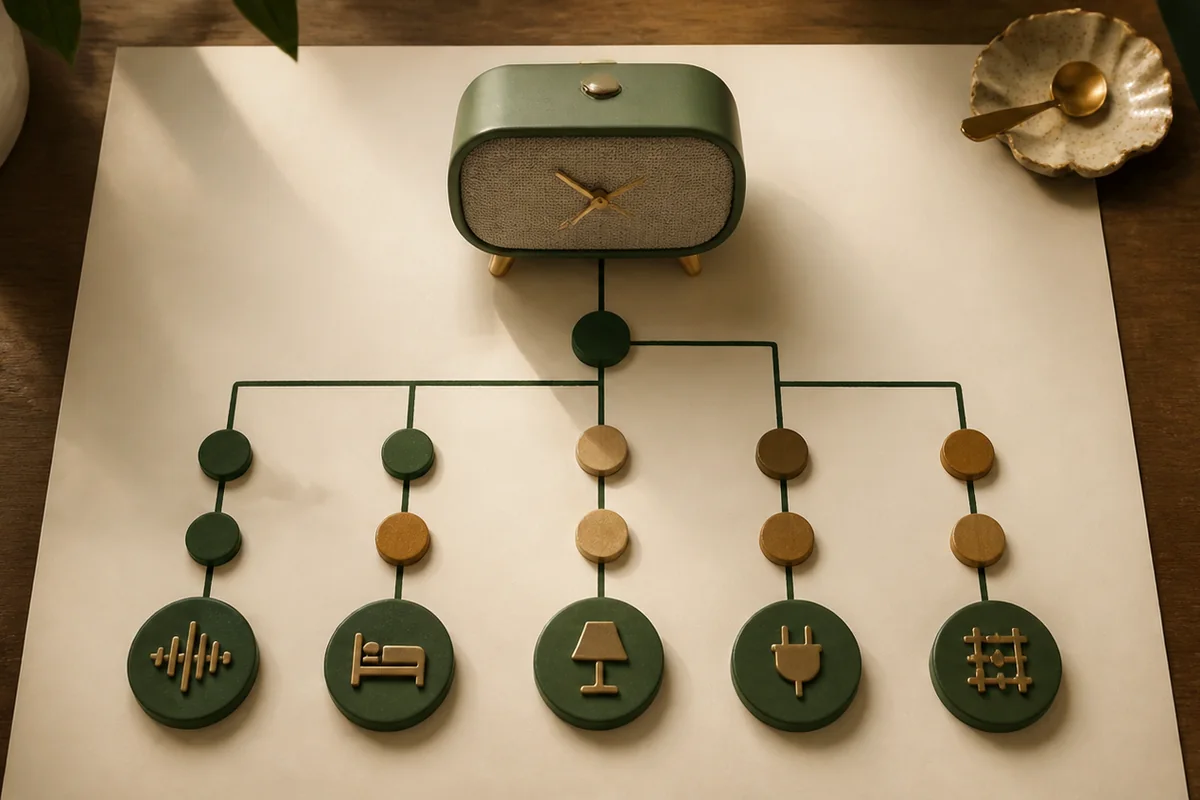
Nonnegotiable checks
The criteria that can change the answer
1. Signal
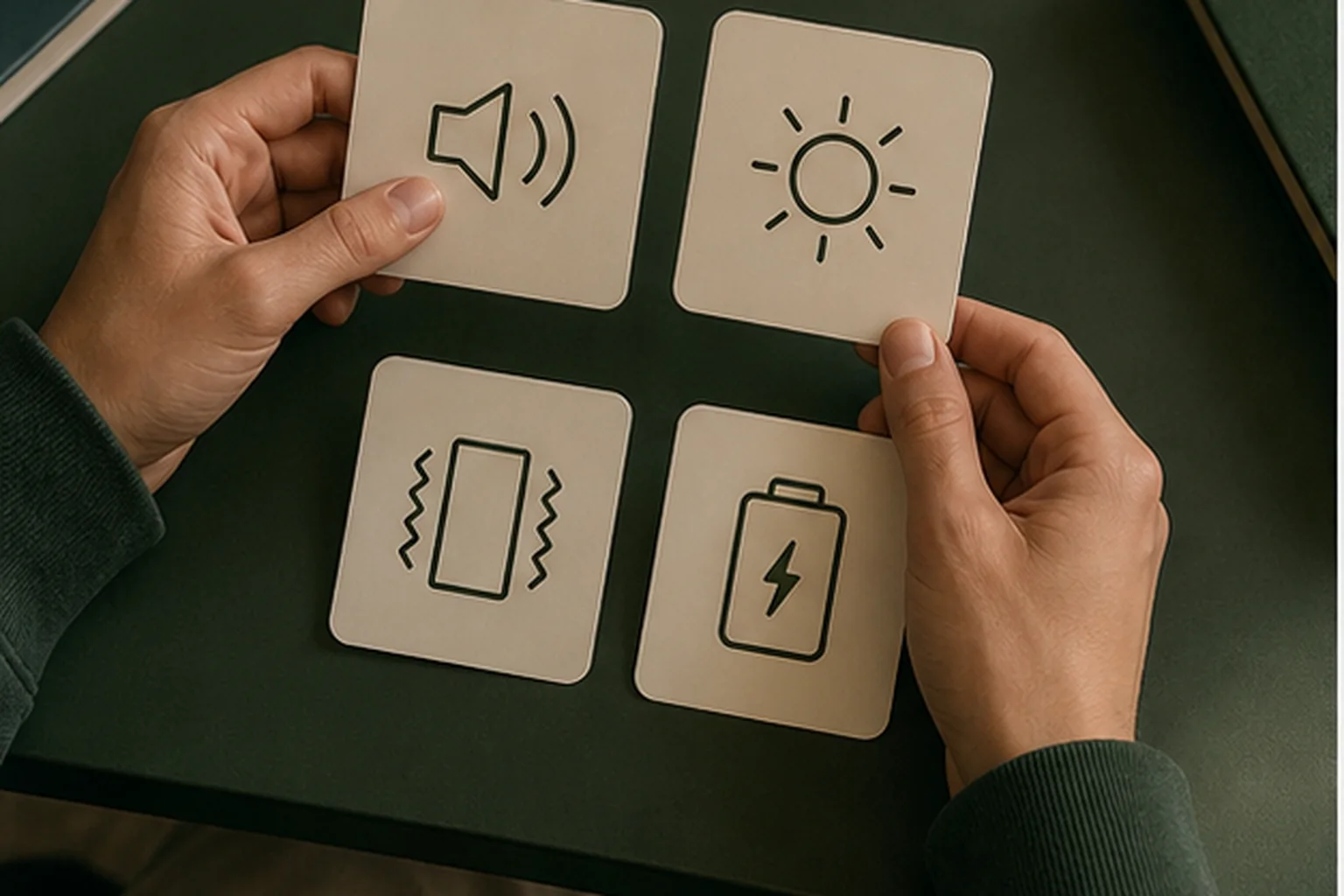
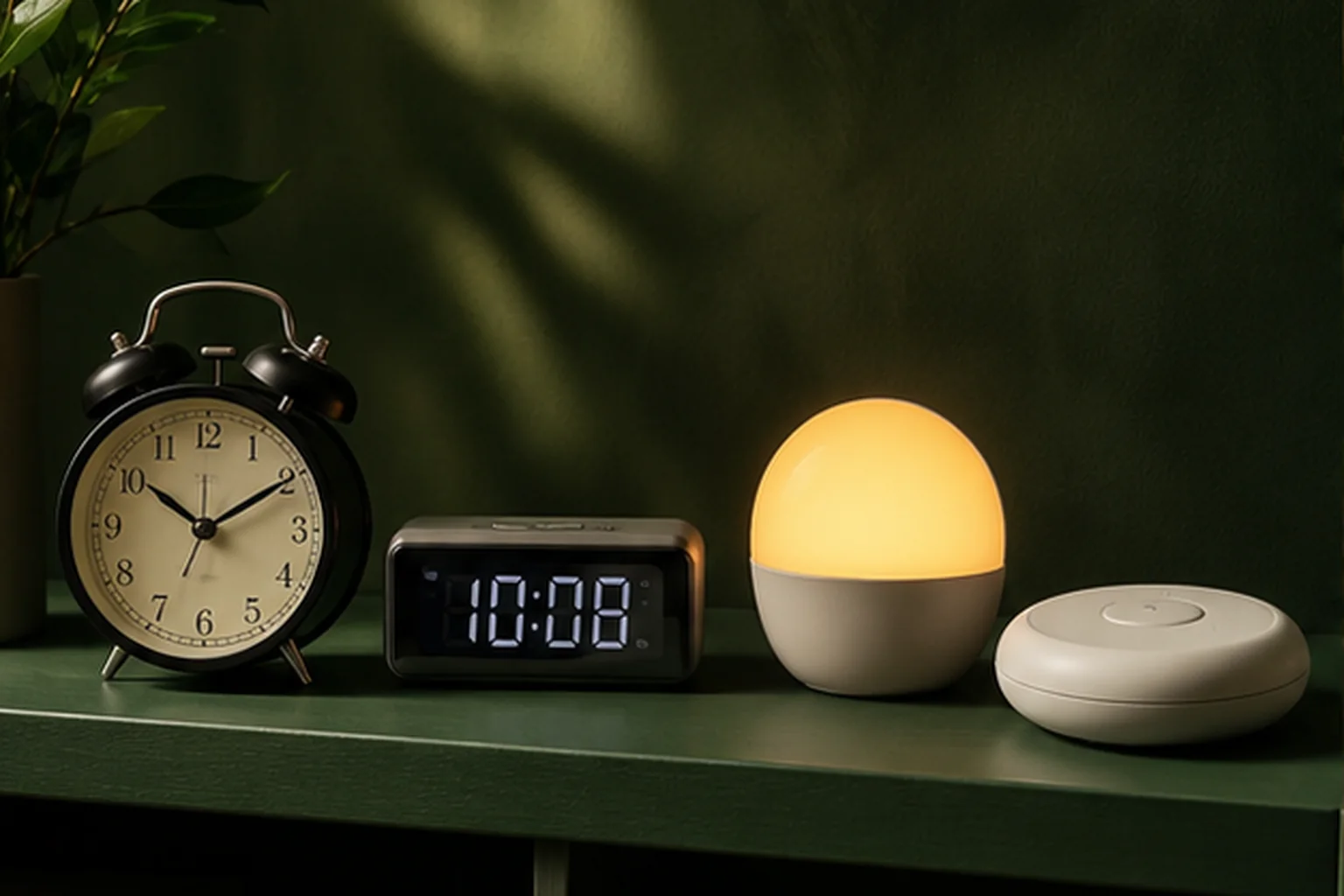
Sound, light, vibration, movement, or a combination.
2. Sleeper and room
Include hearing access, partner impact, darkness, distance, and placement.
3. Power
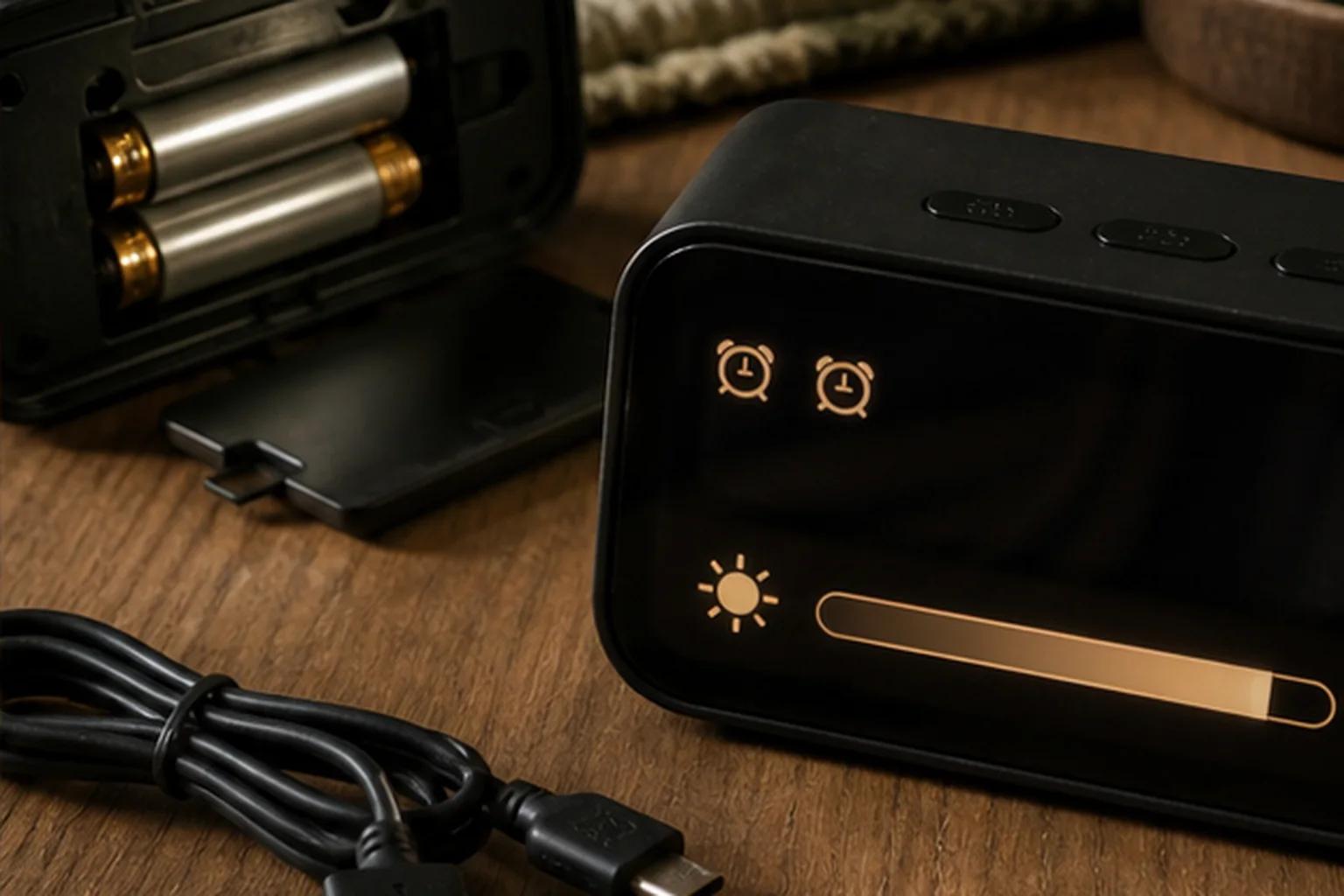
Battery operation, settings retention, or alarm operation during an outage.
4. Controls and dependencies
Night buttons, app, account, Wi-Fi, subscription, and phone access.
What changes in practice
Compare the trade-offs, not the feature count
| Route | Decision value |
|---|---|
| Sound | Immediate and familiar, with room-wide impact. |
| Sunrise light | Begins before wake time, with placement dependence. |
| Vibration | Local physical cue, with placement and connection risk. |
| Smart routine | More configuration, with app and service dependencies. |
Eliminate before ranking
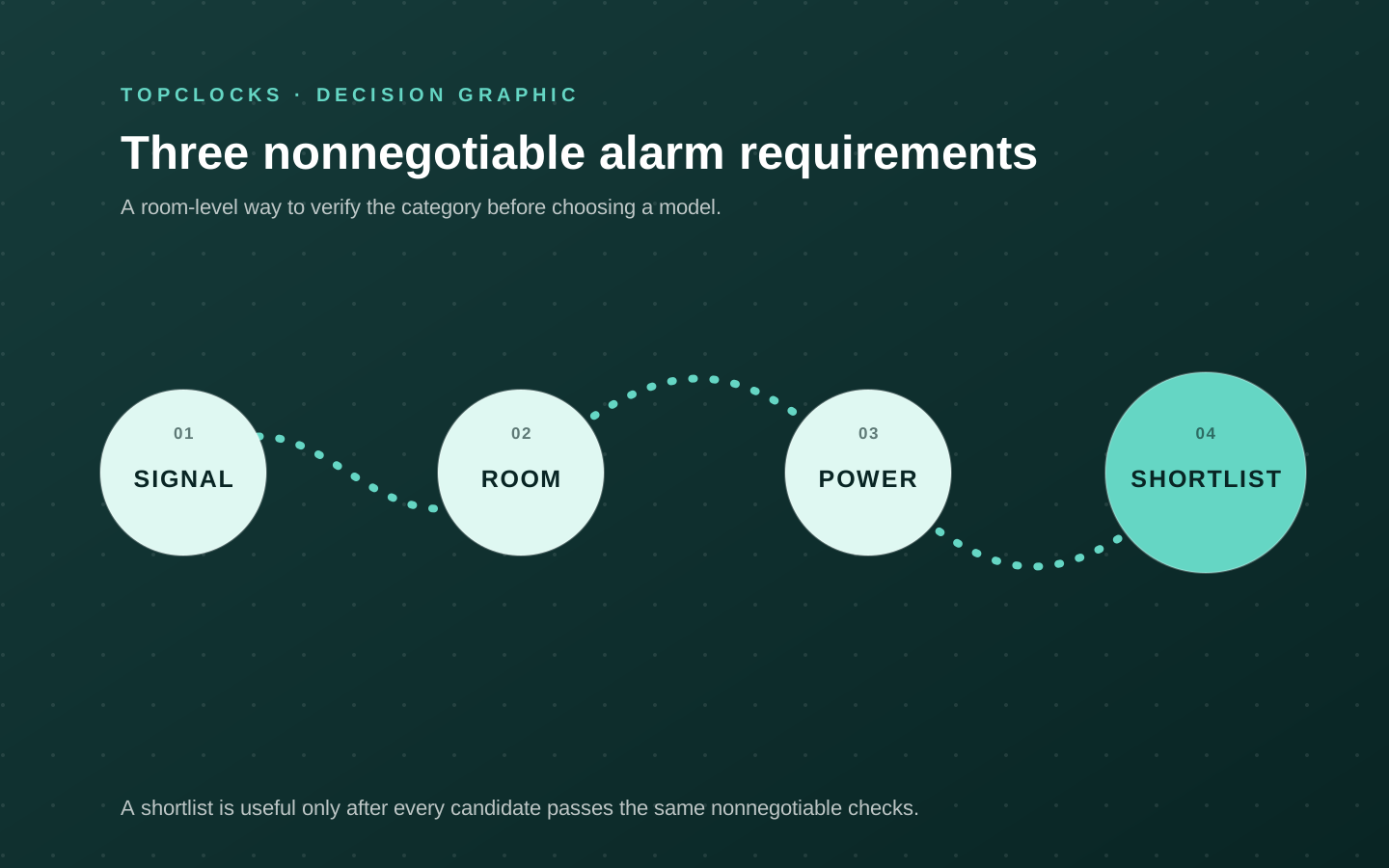
Write three requirements that every candidate must pass
A useful buying process starts with disqualification, not a list of popular clocks. Write the primary wake signal, the room or household boundary, and the power or setup requirement. For example: “tactile alert that does not require sound,” “must not illuminate a partner’s side before 6:00,” and “saved alarm must run without a connected phone.” Another buyer may need “audible adjustable tone,” “true display off,” and “full battery operation for travel.”
Make every requirement observable. “Reliable” is too broad; “alarm sounds during a mains outage while the display may remain dark” can be checked. “Easy to use” is too broad; “set, snooze, stop, and verify alarm state with physical controls in darkness” can be checked. “Good for heavy sleepers” is too broad; “provides adjustable sound plus a shaker placed under this mattress” can be checked.
Limit the list to three nonnegotiables so preferences do not masquerade as failures. A fourth column can hold desired features such as radio, USB-C, color, or a sound library. If a preference becomes important enough to reverse the purchase, promote it and remove another requirement. The process should produce a manageable shortlist, not a specification wish list no model can meet.
- Signal: what must the sleeper hear, see, or feel?
- Room: who else can receive it and where can the device sit?
- Power/setup: what must work during outage, travel, or disconnected use?
- Preferences: which extras decide only after every candidate passes?
Read beyond normal operation
Compare what happens when power, network, placement, or routine goes wrong
Most product pages describe a fully powered clock in a favorable position. Real buying decisions depend on the less visible states. Does a backup battery retain settings or sound the alarm? Does a smart clock run saved routines when Wi-Fi or the phone is unavailable? Does a shaker remain in place through the night? Can a sunrise light reach the sleeper when they face away? Does a dual alarm keep two day patterns and sources separate?
For each candidate, name one likely failure and the evidence needed to accept it. Use the current manual for power, controls, scheduling, and included accessories. Use a room test for signal reach, brightness, vibration, radio reception, and partner impact. Use a disconnected test for app-supported devices. Preserve uncertainty when the source does not answer the question.
Redundancy should target the consequence. A separate battery alarm may cover a mains-powered sunrise clock. A shaker may cover missed sound. A different device across the room may cover automatic silencing. Multiple alarm times on one phone add repetition but retain shared charge, speaker, software, and placement. Buy the backup only after identifying what it must cover.
- List normal state and failure state beside each nonnegotiable feature.
- Remove candidates whose important failure cannot be verified within the return window.
- Use an independent channel or power path for high-consequence mornings.
- Do not reward a model for extras that share the same weak component.
Use it half awake
Controls and placement should be tested in darkness before they are trusted
A clock may be easy to demonstrate under bright light and confusing when the user is half awake. Identify alarm on/off, stop, snooze, volume, brightness, and time-setting controls by touch. Check whether one button changes several states and whether the active alarm remains visible after snooze. For app-based clocks, identify which bedside actions still work without opening the phone.
Placement connects features to the sleeper. A speaker can be covered or too close to silence automatically. A sunrise lamp can be blocked below the pillow line. A shaker can be damped or disconnected. A projection beam can miss the usable ceiling surface. A charger can place the phone over buttons. Measure distance, cable reach, sightline, and control clearance before design or color decides.
If moving the clock across the room is part of the waking action, test audibility and a safe route. If the room is shared, test spillover. If the clock travels, perform the setup in an unfamiliar position. The ideal location may expose a product constraint that no specification comparison showed.
- Practice setting and stopping a short alarm without the manual.
- Confirm the active state after stop, snooze, and a power cycle.
- Measure the physical path for sound, light, vibration, projection, and cables.
- Ask other sleepers what they hear, see, or feel from the planned setup.
Finish the purchase after testing
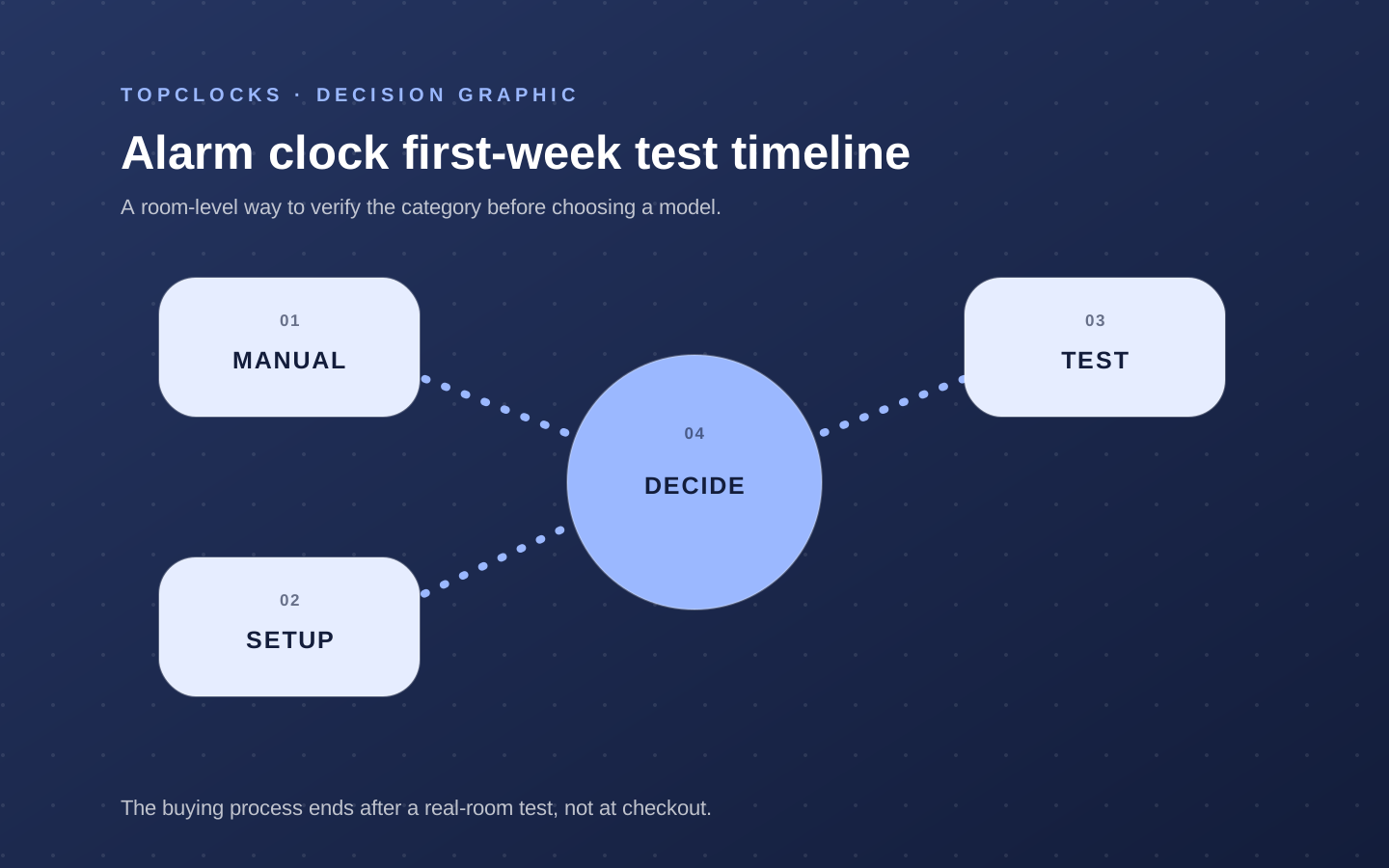
Use the return window as a structured first-week verification period
Day one should establish source facts and basic operation. Save the official product page and manual, inspect the exact model number and included components, set time and alarm, and confirm the controls. Day two should test the room: signal reach, darkest display, placement, partner impact, and stop behavior. Day three should test the relevant failure state, such as mains loss, disconnected phone, or shaker displacement, during the day.
Then run ordinary low-stakes mornings. Record failures by link rather than saying the clock “did not work.” If the alarm never started, inspect schedule and power. If it started and was missed, inspect signal and placement. If it was stopped automatically, inspect controls and waking action. Change one variable and retest. Do not wait until the end of the return period to discover that a nonnegotiable feature was misunderstood.
At the end of the week, confirm that every nonnegotiable requirement has evidence: source-backed behavior and, where needed, room-tested performance. Optional features should remain useful without obscuring the alarm state. Keep an independent backup until the new path has earned trust. Re-test after moves, bedding changes, battery replacement, or major updates.
- Day 1: source, model, controls, and active alarm.
- Day 2: placement, signal reach, darkness, and household impact.
- Day 3: documented power, offline, or accessory failure state.
- Days 4–7: normal mornings, one-variable adjustments, and final keep/return decision.
The best alarm clock is the candidate that passes the buyer’s three requirements in the real room with understandable maintenance. A universal ranking cannot perform that work.
Verify in the room
Write three nonnegotiables before opening product pages
The shortlist becomes useful when the buyer can state the required signal, power behavior, and room constraint before comparing price or design. A fourth or fifth requirement should earn its place by preventing a known failure. Treat this as a selection experiment for choosing an alarm clock, not a claim that one model will work for every sleeper. The objective is to expose a mismatch while the clock can still be returned, moved, or reconfigured.
Describe the sleeper, room, nightstand, outlet, bedding, schedule, bystanders, and consequence of a missed alarm. Use that description to remove categories before comparing models. Keep the first run deliberately ordinary. Extreme settings can hide a placement problem, and a special one-night routine does not show whether the setup is maintainable on workdays, school days, weekends, and schedule changes.
The buying process fails when features accumulate without priority, retailer labels replace operating details, or a model stays on the list despite one nonnegotiable mismatch. Write the likely failure before running the test. That note prevents a bright display, attractive sound library, charging pad, or app from receiving credit for a wake path it cannot protect.
For each finalist, record the exact model number, official manual, primary cue, outage behavior, controls, active-alarm indicator, placement fit, and planned return-window test. A simple dated log is enough. Avoid converting one successful morning into a universal result; repeat the check after changing bedding, furniture, power, software, room, or schedule because the signal path may have changed.
- Primary wake signal: write the observed state, not a yes-or-no impression. Add the condition that produced it and the next check if the result was unclear.
- Power behavior: write the observed state, not a yes-or-no impression. Add the condition that produced it and the next check if the result was unclear.
- Room constraint: write the observed state, not a yes-or-no impression. Add the condition that produced it and the next check if the result was unclear.
- Schedule pattern: write the observed state, not a yes-or-no impression. Add the condition that produced it and the next check if the result was unclear.
- Night controls: write the observed state, not a yes-or-no impression. Add the condition that produced it and the next check if the result was unclear.
- Return-window verification: write the observed state, not a yes-or-no impression. Add the condition that produced it and the next check if the result was unclear.
A shortlist passes when every surviving model meets all nonnegotiables and differs only on trade-offs the buyer can accept. Reject a candidate immediately when one documented behavior conflicts with a requirement; do not let optional extras average out a disqualifier. If the result is mixed, do not average it into a score. Preserve the unresolved condition and compare only models that give you a direct way to verify it.
When reading product pages for choosing an alarm clock, translate each promising label back into an observable state. “Reliable” should identify the cue that survives the expected power and dependency conditions. “Easy to use” should identify who sets the alarm, in what light, and how the active state is confirmed. “Best” should disappear unless the scenario and disqualifiers are stated beside it.
Close the hidden gaps
Questions that settle a choice about choosing an alarm clock
For choosing an alarm clock, these questions close the gaps left by retailer filters and broad “best alarm” lists. Each answer is a boundary for the shortlist, not a promise about an untested model.
What should be tested before buying choosing an alarm clock?
Describe the sleeper, room, nightstand, outlet, bedding, schedule, bystanders, and consequence of a missed alarm. Use that description to remove categories before comparing models. Use the exact device revision and current manual when a control, accessory, app, or backup behavior affects the result.
Which failure should be ruled out first?
The buying process fails when features accumulate without priority, retailer labels replace operating details, or a model stays on the list despite one nonnegotiable mismatch. Test that failure first, while the consequences are low, instead of increasing every setting at once.
How many checks make the result dependable?
Within this review of choosing an alarm clock, one successful check confirms that the setup can work; it does not show that it is robust. Repeat it on ordinary mornings and after any change that affects the signal, power, placement, schedule, or stop action. High-consequence mornings deserve an independently tested backup.
Can specifications settle the choice?
Specifications and manuals can narrow the shortlist for choosing an alarm clock by establishing intended controls, compatibility, power requirements, and operating states. They cannot establish what one sleeper will hear, see, or feel through a particular room and bed. Keep documented facts and room observations separate.
When should a candidate for choosing an alarm clock leave the shortlist?
Reject a candidate immediately when one documented behavior conflicts with a requirement; do not let optional extras average out a disqualifier. A disqualifier should remove the model before price, design, reviews, or optional content are compared.
What does a passing result look like?
A shortlist passes when every surviving model meets all nonnegotiables and differs only on trade-offs the buyer can accept. The result should be visible in the log and repeatable without a special workaround that the household is unlikely to maintain.
Finish the decision about choosing an alarm clock by writing one sentence: “This setup should wake this person, in this room, through this signal, under these power conditions, and it will be checked this way.” If any blank remains, the page has identified the next research task rather than pretending the purchase is settled.
Before relying on it
Run the complete alarm path
A product page can confirm features. Only a real setup check confirms that the selected signal, placement, controls, and power path work together in the room.
- Write three nonnegotiable needs.
- Eliminate any model that misses one.
- Read the power and alarm sections of the manual.
- Test the clock before a high-stakes morning.
Role-based product shortlist
Models worth comparing for this decision
These are desk-researched candidates, not a claim that one clock wins for everyone. Each card explains the scenario it fits, the limitation to verify, and the primary source used for the factual details.
Compare for a self-contained sunrise alarm
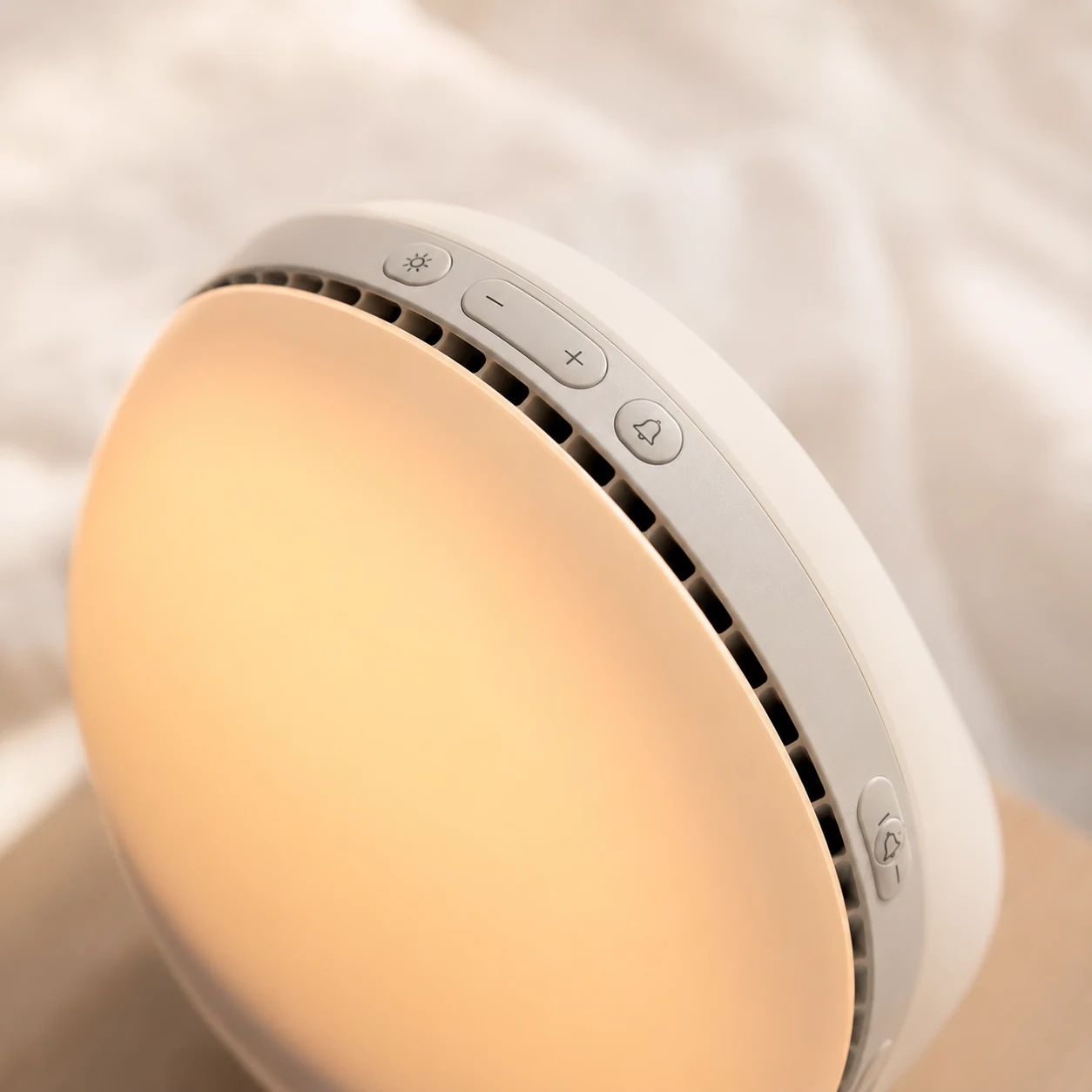
Philips SmartSleep HF3520/60
HF3520/60 tests several buying questions at once: signal timing, light placement, physical controls, and mains-power behavior.
HF3520/60 provides an adjustable 20-, 25-, 30-, 35-, or 40-minute sunrise simulation, two alarm profiles, natural wake sounds, FM radio, tap snooze, and bedside controls without requiring an app or subscription. The default sunrise duration is 30 minutes.
Compare for compact, app-free travel use
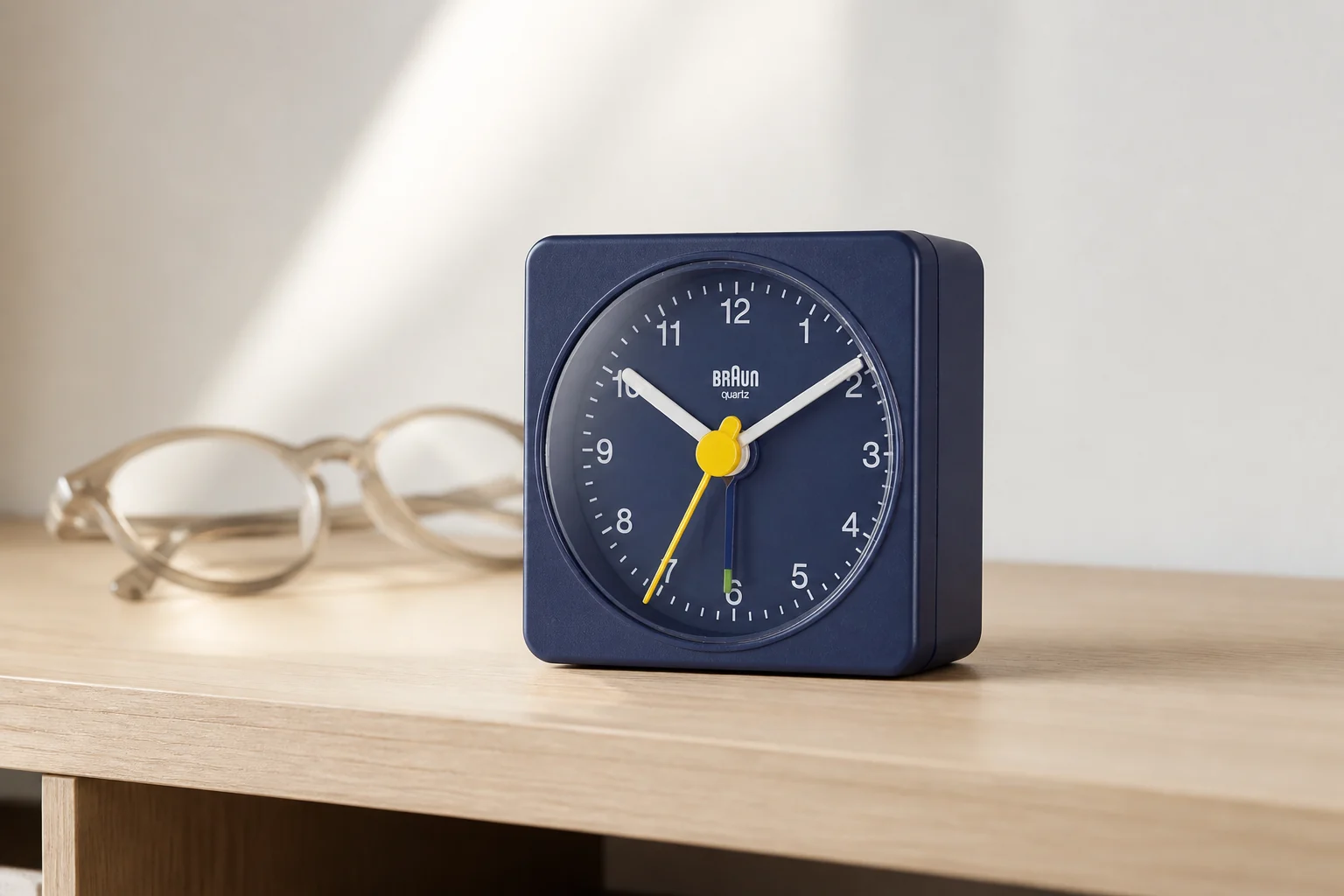
Braun BC02
BC02 shows when a short feature list is enough because power, controls, and portability are all easy to verify.
BC02 is a 57 mm square analog clock powered by one AA battery. It uses a quiet quartz tick movement, luminous-tipped hands, and a crescendo beep without an app, account, or wall outlet.
Compare for app-built light and sound routines
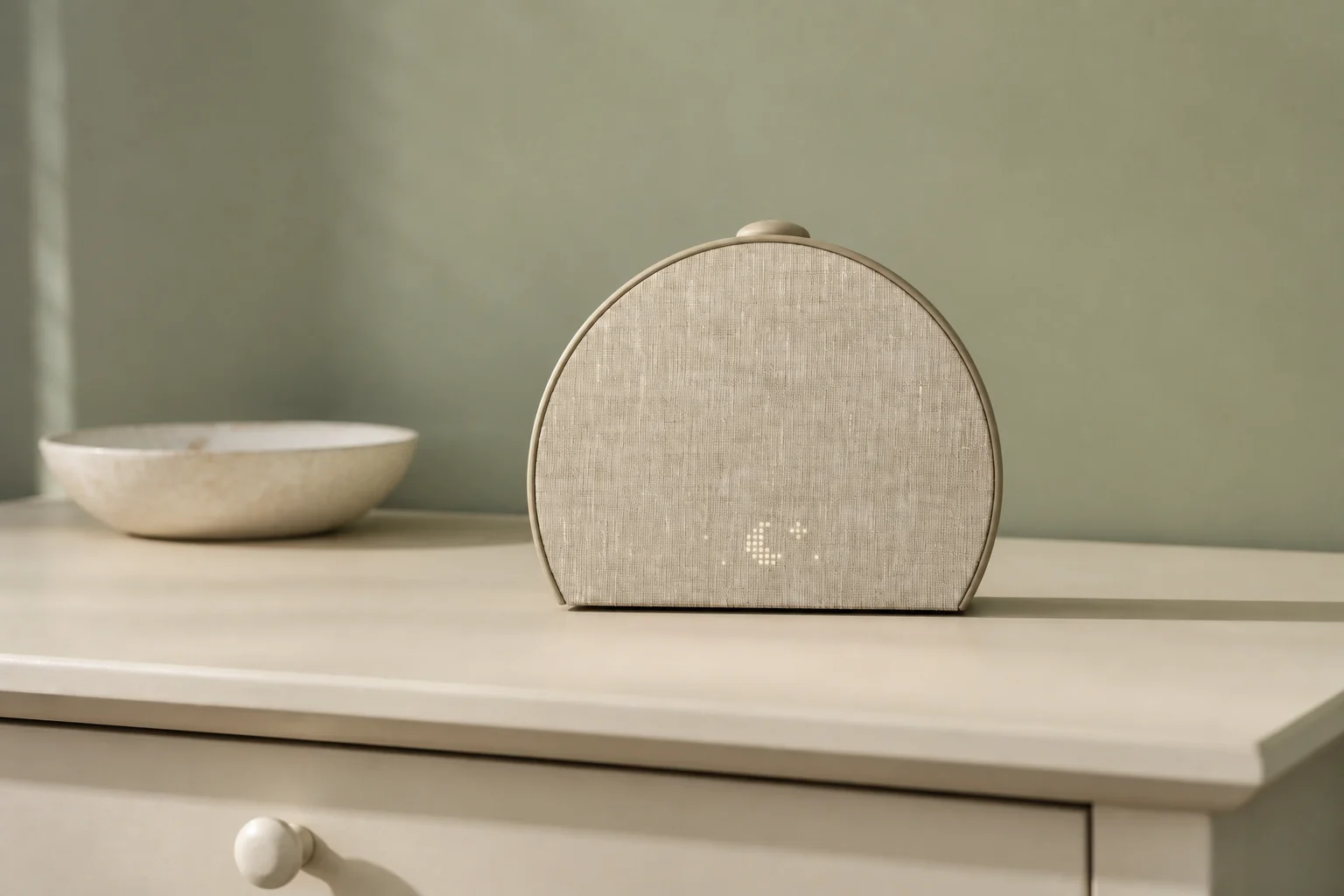
Hatch Restore 3
Restore 3 is the dependency check: the routine may be flexible, but app, account, Wi-Fi, and optional subscription terms still count.
Restore 3 combines sunrise light, sound routines, and more direct device controls than earlier Restore models. A phone is still required for setup and customization, while core routines can be used from the clock afterward.
Evidence trail