Alarm clock type
Alarm Clock Radios: Tune the Wake Source, Not Just the Station
Radio adds a changing wake source, but reception and source fallback become part of the alarm path.
The decision first
Do you need radio as the wake source or as bedside audio?
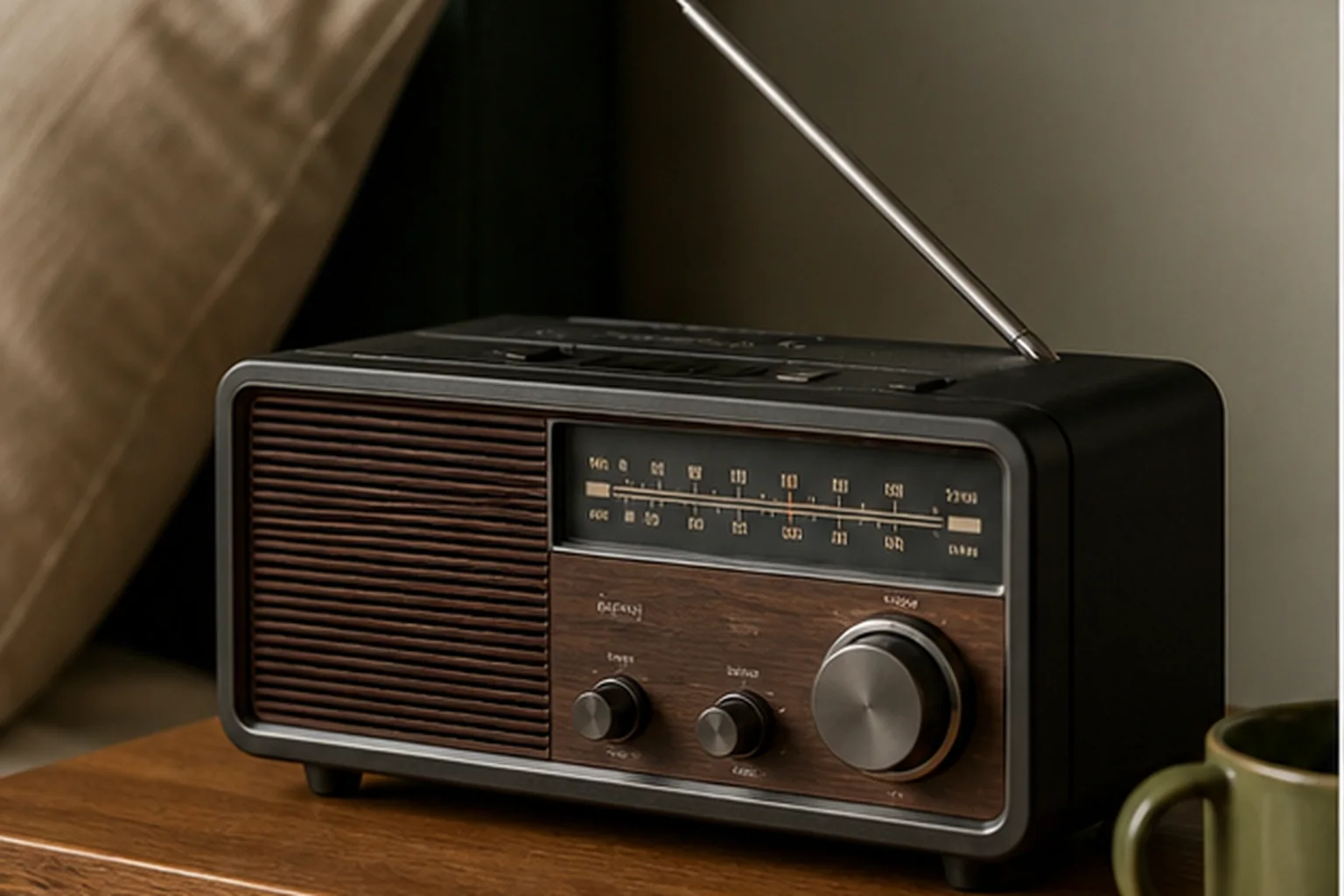
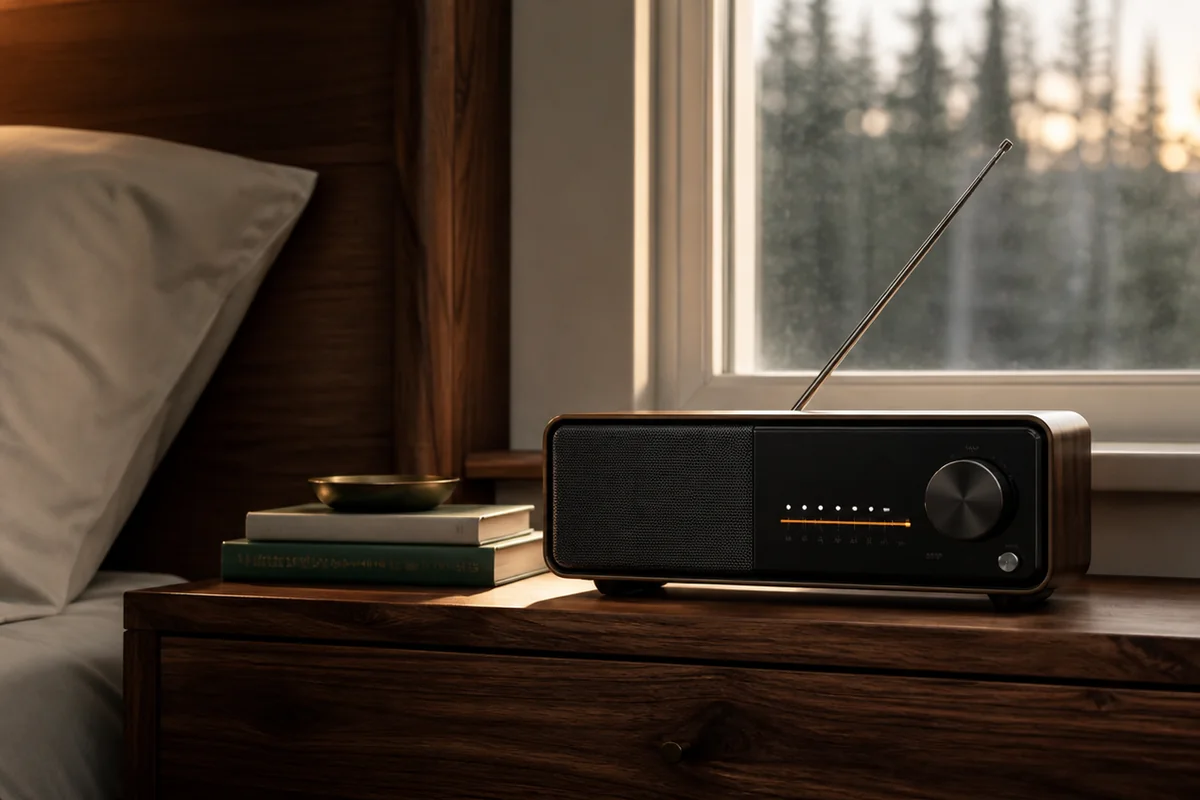
A clock radio fits when broadcast audio is the preferred signal and reception is stable at the bedside. Verify whether the alarm falls back to a buzzer when the station or source is unavailable. Check presets, antenna position, alarm volume, and backup behavior.
Nonnegotiable checks
The criteria that can change the answer
Reception
Test the station where the clock will stay, with the antenna extended.
Fallback source
A buzzer provides a clearer failure path than silence.
Alarm volume
Separate wake volume from normal listening volume when possible.
Schedule
Dual alarms and weekday/weekend rules may matter more than preset count.
What changes in practice
Compare the trade-offs, not the feature count
| Route | Decision value |
|---|---|
| FM wake | Varied content, but dependent on reception and station behavior. |
| Built-in tone | More predictable, but less varied. |
| Bluetooth wake | Personal audio, with pairing and phone dependencies. |
| Preset radio | Fast station choice, provided setup survives outages. |
Define the radio job
Waking to radio requires more than a tuner and speaker
A clock radio can mean a basic alarm that offers FM as one source or a substantial bedside audio system with alarms added. If waking to a station is the nonnegotiable job, verify the entire route: reception at nightstand height, saved preset, selected alarm source, alarm-specific volume, schedule, and fallback when the station cannot be received. A product with excellent Bluetooth audio may not allow streamed content to be selected as a reliable wake source.
Test reception where the clock will remain, with its normal antenna position and nearby electronics operating. A station that sounds clear across the room may be noisy or unstable at the nightstand. Confirm whether the alarm uses the last-played station, a designated preset, or a fixed source. Check what happens when reception fails: silence, static, or an automatic buzzer. The fallback can be more important than the number of presets.
Separate listening volume from alarm volume. Some models remember different levels; others use a shared setting or an ascending alarm rule. A low bedtime listening level should not silently become an inadequate wake level, and a loud wake setting should not surprise the user during ordinary playback. The manual should explain the relationship.
- Save the intended station, power-cycle the clock, and confirm the preset remains.
- Set a short radio alarm and verify the source and actual starting volume.
- Identify the fallback when tuning or reception fails.
- Confirm whether Bluetooth, aux, or streaming audio can be an alarm source rather than only a listening input.
Pay for the role you need
Audio-first and alarm-first devices trade space, controls, and sound
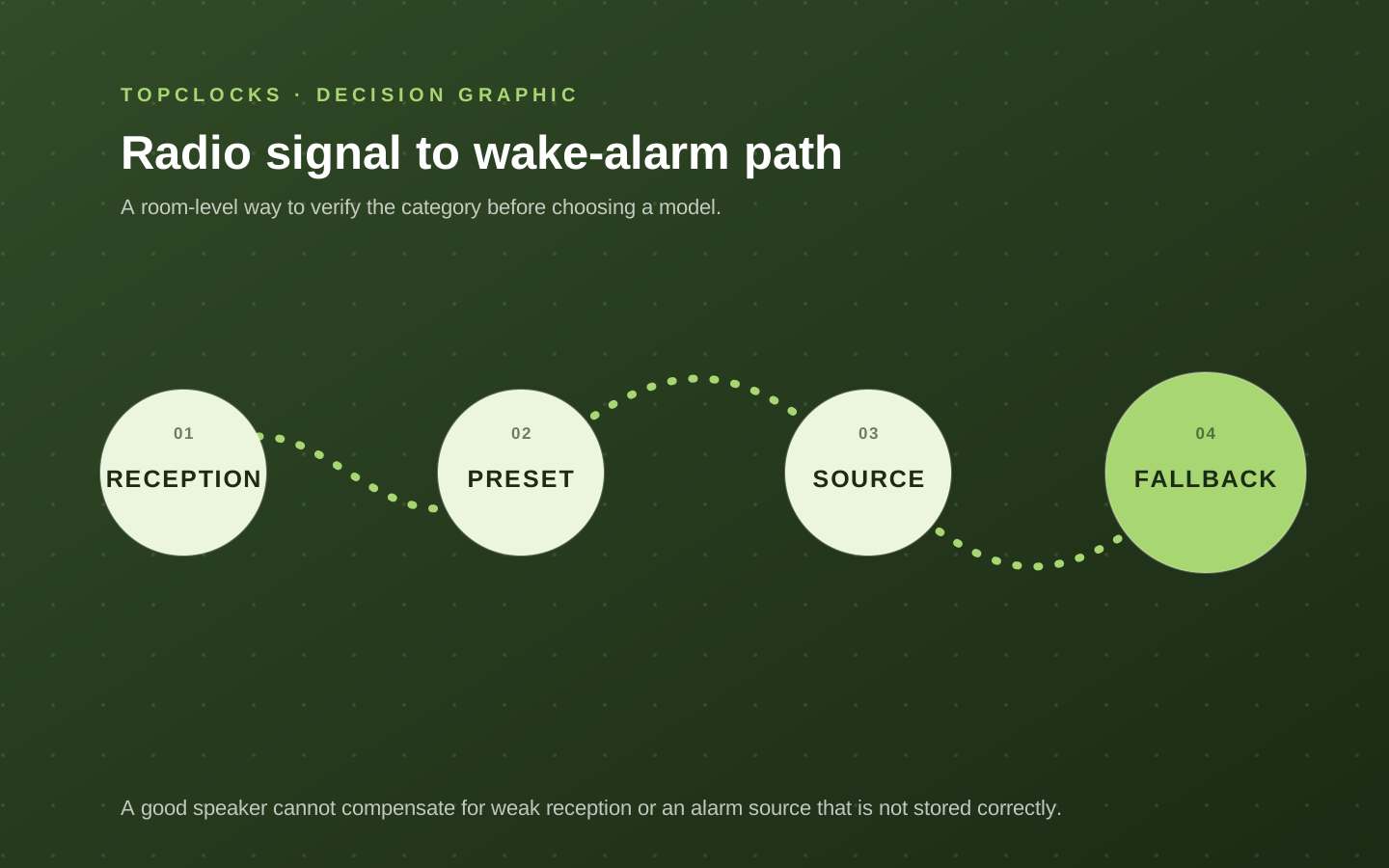
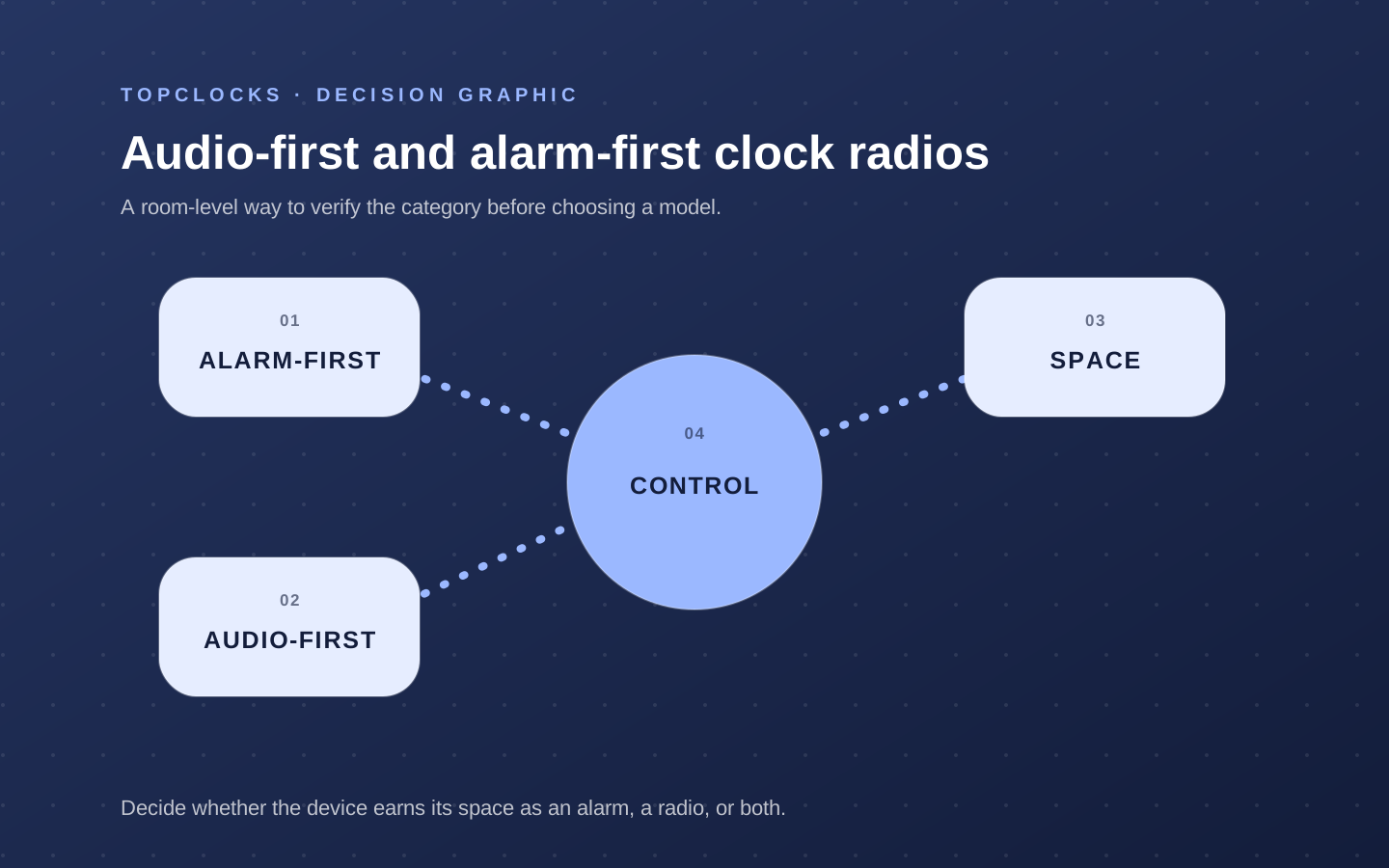
An alarm-first clock radio typically prioritizes a visible time display, direct alarm buttons, snooze, compact size, and a basic speaker. An audio-first system may add a larger cabinet, better speaker, AM/FM or RDS information, Bluetooth, auxiliary input, remote control, and charging. The second route earns its footprint only when radio or audio is a real daily job. Otherwise the extra inputs and controls can make the alarm state harder to inspect.
Evaluate sound quality separately from wake reliability. Speaker size, tone controls, and stereo or bass features may improve listening. Alarm reliability still depends on saved source, schedule, volume, controls, power, and fallback. A large device can be easier to hear and harder to place. A compact device can keep controls close and provide thinner sound. Neither is automatically better for the clock’s primary job.
Consider nighttime control paths. Dedicated preset, alarm, volume, and source buttons are easier to verify than a multi-function dial when half awake. A remote can help from bed and become another item to locate. A bright information display can serve radio use and disturb sleep. Look for separate dimming or off behavior and a clear active-alarm indicator.
- Choose audio-first when listening quality, reception, and inputs justify the larger footprint.
- Choose alarm-first when direct controls and compact placement matter more than fuller sound.
- Verify alarm-source and alarm-volume behavior on either route.
- Reject extra audio features that block placement or make the wake state harder to understand.
Check tomorrow morning
Dual schedules and backup labels do not prove independent operation
Clock radios commonly advertise dual alarms, weekday/weekend modes, and battery backup. Translate each label. Can Alarm 1 and Alarm 2 use different days and sources? Can one wake to radio and the other to a buzzer? Is volume independent? Which indicators show they are active? What does snooze affect? Two time slots may still share a source, speaker, volume, and power path.
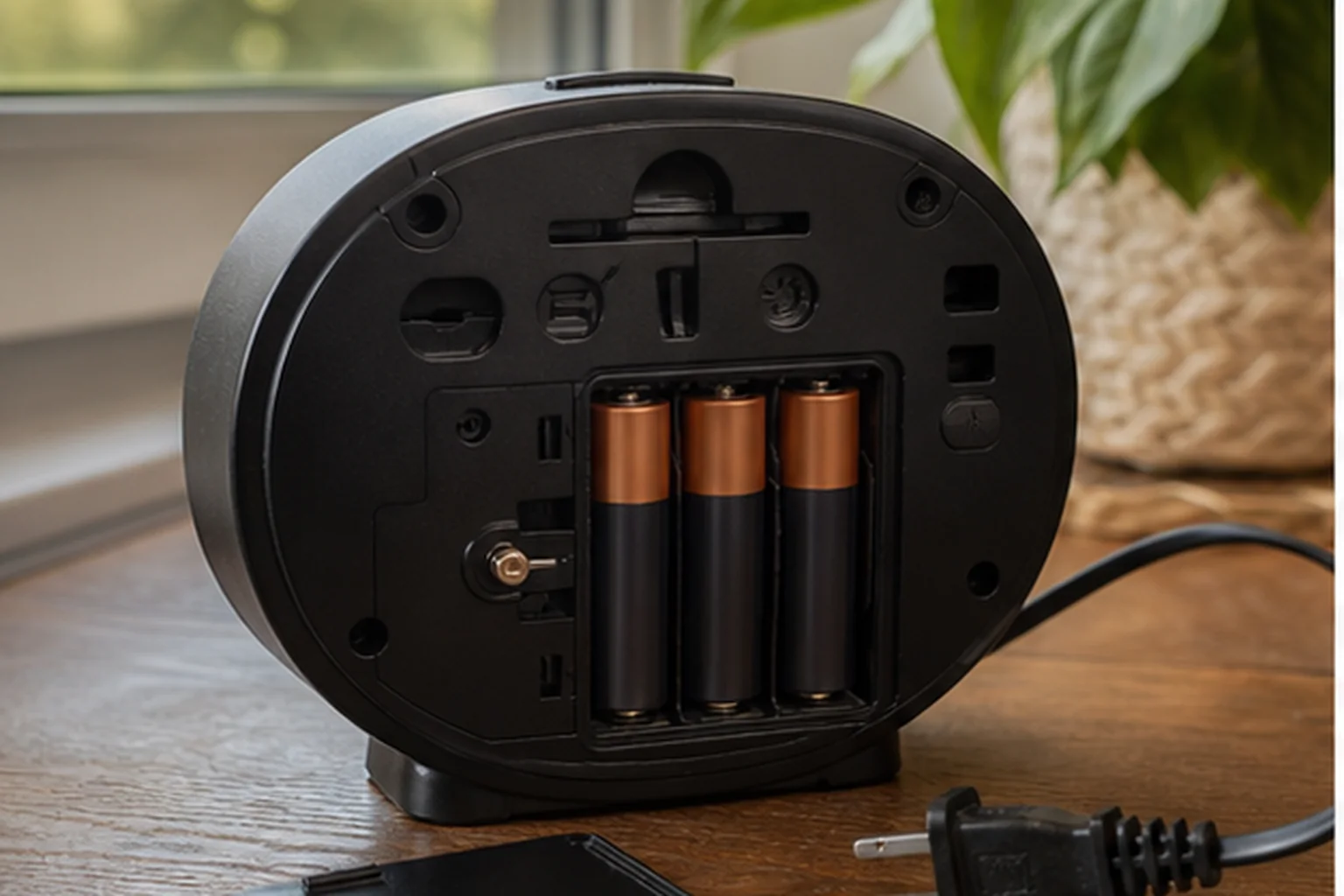
Backup behavior is especially important for a radio alarm because a small cell is unlikely to power the full tuner, display, and speaker as in normal operation. The clock may retain settings and remain silent during an outage, or it may sound a basic buzzer while radio and display stay off.
Read the exact model’s manual and run a safe daytime unplug test when the behavior matters. Charging ports and Bluetooth playback normally depend on mains.
Automatic time setting can reduce reset work and introduce its own mechanism: stored calendar data, radio time signal, phone pairing, or network. Confirm how DST and manual override work. A clock that restores time after an outage may still require the alarm source or preset to be verified.
- Set two alarms with different times, days, and sources, then confirm each active indicator.
- Test the radio alarm after a power cycle and after the relevant outage state.
- Separate setting retention from audible backup and from full radio operation.
- Use a second independent device when a station alarm must be backed up for a high-consequence morning.
Compare complete roles
Shortlist an audio-first model, a conventional radio clock, and a light-led alternative
An audio-first model such as a larger Sangean route is useful when the device must be a capable radio and speaker as well as an alarm.
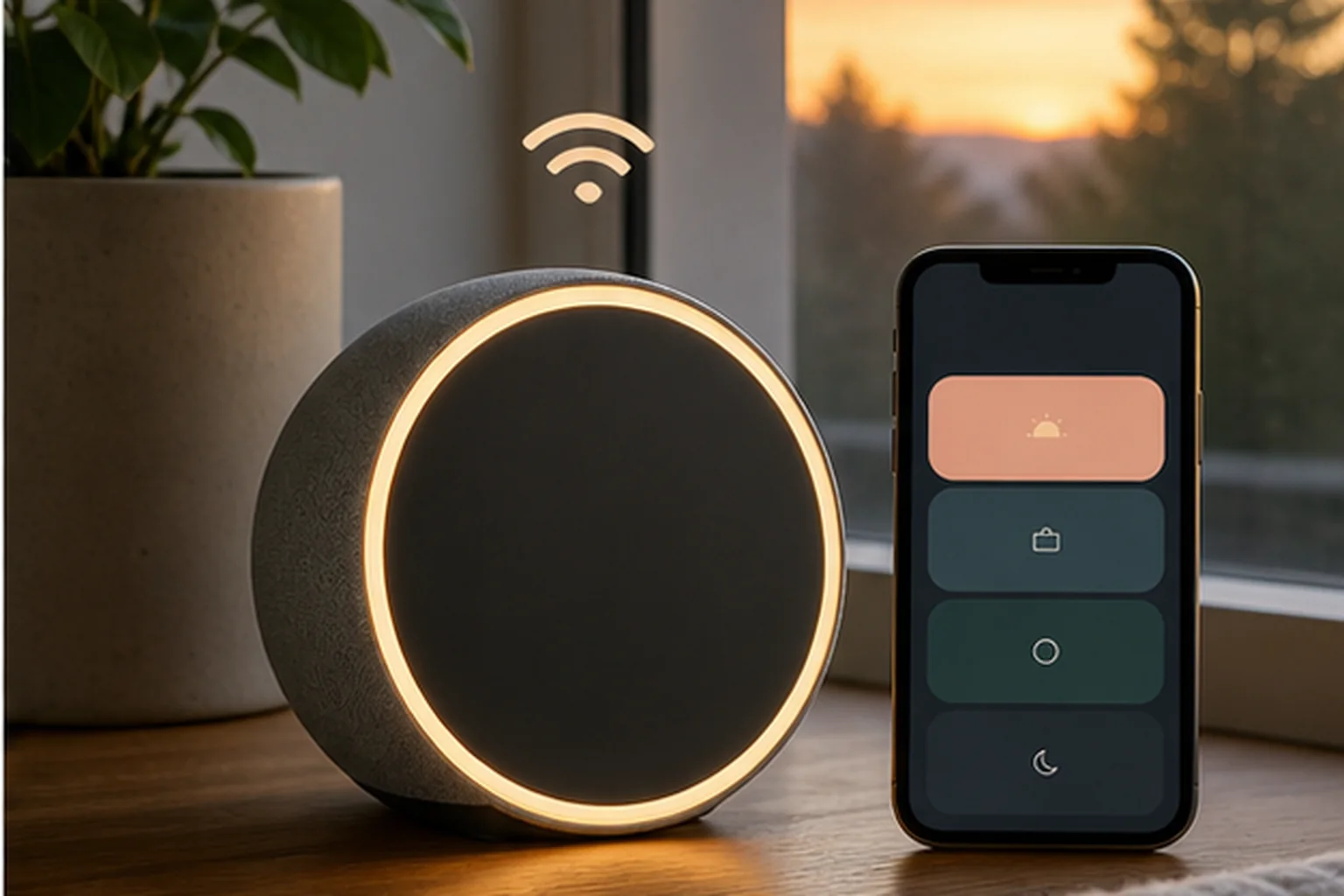
A conventional Emerson-style route fits the user who wants FM, dual schedules, a buzzer fallback, Bluetooth listening, and straightforward charging without a large cabinet. A sunrise-radio model adds gradual light and sunset routines, changing the comparison from speaker features to cue timing and room light. These candidates answer different jobs.
Build a worksheet for each exact model: tuner bands, presets, antenna, alarm sources, separate alarm volume, two-alarm independence, day patterns, display states, dimensions, power input, backup behavior, charging outputs, and Bluetooth or auxiliary limitations. Use current manufacturer sources. Do not infer a wake source from a playback feature or transfer a manual between similar model names.
Run the test in the room. Check reception at night and after moving the antenna. Save the station, set a short alarm, lower normal listening volume, and confirm the wake level. Test both alarms if the feature matters. Dim or switch off the display and verify the alarm state. Perform the documented power test during the day. Ask a partner about sound and display spillover.
- Reject a radio route that cannot hold the intended station or provide an acceptable fallback.
- Reject a large audio system when its footprint forces poor speaker, display, or control placement.
- Reject a dual-alarm implementation that lacks the independence the household requires.
- Prefer the model whose wake source and fallback remain obvious after reset and outage tests.
A clock radio should be chosen because radio is a verified part of the morning or nightstand routine, not because the tuner adds one more checkmark.
Verify in the room
Separate radio listening from radio wake-up reliability
A clock radio may be bedside audio, an alarm source, or both. The purchase changes when reception and saved-station behavior matter at wake time rather than only during evening listening. Treat this as a selection experiment for alarm clock radios, not a claim that one model will work for every sleeper. The objective is to expose a mismatch while the clock can still be returned, moved, or reconfigured.
Tune the intended station at the exact nightstand position and repeat the check with nearby chargers, lamps, and phones connected as they normally are. Confirm the antenna arrangement the room allows. Keep the first run deliberately ordinary. Extreme settings can hide a placement problem, and a special one-night routine does not show whether the setup is maintainable on workdays, school days, weekends, and schedule changes.
Radio wake fails when reception fades, the station is not saved, the wrong band or source remains selected, or the clock lacks an acceptable buzzer fallback. Write the likely failure before running the test. That note prevents a bright display, attractive sound library, charging pad, or app from receiving credit for a wake path it cannot protect.
Record station, signal stability, saved preset, alarm source, wake volume, fallback behavior, and the source selected after a power interruption. A simple dated log is enough. Avoid converting one successful morning into a universal result; repeat the check after changing bedding, furniture, power, software, room, or schedule because the signal path may have changed.
- Local reception: write the observed state, not a yes-or-no impression. Add the condition that produced it and the next check if the result was unclear.
- Antenna placement: write the observed state, not a yes-or-no impression. Add the condition that produced it and the next check if the result was unclear.
- Saved preset: write the observed state, not a yes-or-no impression. Add the condition that produced it and the next check if the result was unclear.
- Alarm source selection: write the observed state, not a yes-or-no impression. Add the condition that produced it and the next check if the result was unclear.
- Wake volume: write the observed state, not a yes-or-no impression. Add the condition that produced it and the next check if the result was unclear.
- Buzzer fallback: write the observed state, not a yes-or-no impression. Add the condition that produced it and the next check if the result was unclear.
A clock radio passes when the chosen station starts predictably and a documented fallback covers the plausible reception or source failure. Reject radio as the primary cue when local reception is unstable and the model cannot provide a separate alarm source that the sleeper accepts. If the result is mixed, do not average it into a score. Preserve the unresolved condition and compare only models that give you a direct way to verify it.
When reading product pages for alarm clock radios, translate each promising label back into an observable state. “Reliable” should identify the cue that survives the expected power and dependency conditions. “Easy to use” should identify who sets the alarm, in what light, and how the active state is confirmed. “Best” should disappear unless the scenario and disqualifiers are stated beside it.
Close the hidden gaps
Questions that settle a choice about alarm clock radios
For alarm clock radios, these questions close the gaps left by retailer filters and broad “best alarm” lists. Each answer is a boundary for the shortlist, not a promise about an untested model.
What should be tested before buying alarm clock radios?
Tune the intended station at the exact nightstand position and repeat the check with nearby chargers, lamps, and phones connected as they normally are. Confirm the antenna arrangement the room allows. Use the exact device revision and current manual when a control, accessory, app, or backup behavior affects the result.
Which failure should be ruled out first?
Radio wake fails when reception fades, the station is not saved, the wrong band or source remains selected, or the clock lacks an acceptable buzzer fallback. Test that failure first, while the consequences are low, instead of increasing every setting at once.
How many checks make the result dependable?
Within this review of alarm clock radios, one successful check confirms that the setup can work; it does not show that it is robust. Repeat it on ordinary mornings and after any change that affects the signal, power, placement, schedule, or stop action. High-consequence mornings deserve an independently tested backup.
Can specifications settle the choice?
Specifications and manuals can narrow the shortlist for alarm clock radios by establishing intended controls, compatibility, power requirements, and operating states. They cannot establish what one sleeper will hear, see, or feel through a particular room and bed. Keep documented facts and room observations separate.
When should a candidate for alarm clock radios leave the shortlist?
Reject radio as the primary cue when local reception is unstable and the model cannot provide a separate alarm source that the sleeper accepts. A disqualifier should remove the model before price, design, reviews, or optional content are compared.
What does a passing result look like?
A clock radio passes when the chosen station starts predictably and a documented fallback covers the plausible reception or source failure. The result should be visible in the log and repeatable without a special workaround that the household is unlikely to maintain.
Finish the decision about alarm clock radios by writing one sentence: “This setup should wake this person, in this room, through this signal, under these power conditions, and it will be checked this way.” If any blank remains, the page has identified the next research task rather than pretending the purchase is settled.
Before relying on it
Run the complete alarm path
A product page can confirm features. Only a real setup check confirms that the selected signal, placement, controls, and power path work together in the room.
- Test reception at nightstand height.
- Find the fallback alarm source.
- Confirm separate alarm volume.
- Read what the backup battery powers.
Role-based product shortlist
Models worth comparing for this decision
These are desk-researched candidates, not a claim that one clock wins for everyone. Each card explains the scenario it fits, the limitation to verify, and the primary source used for the factual details.
Compare for radio and fuller bedside audio
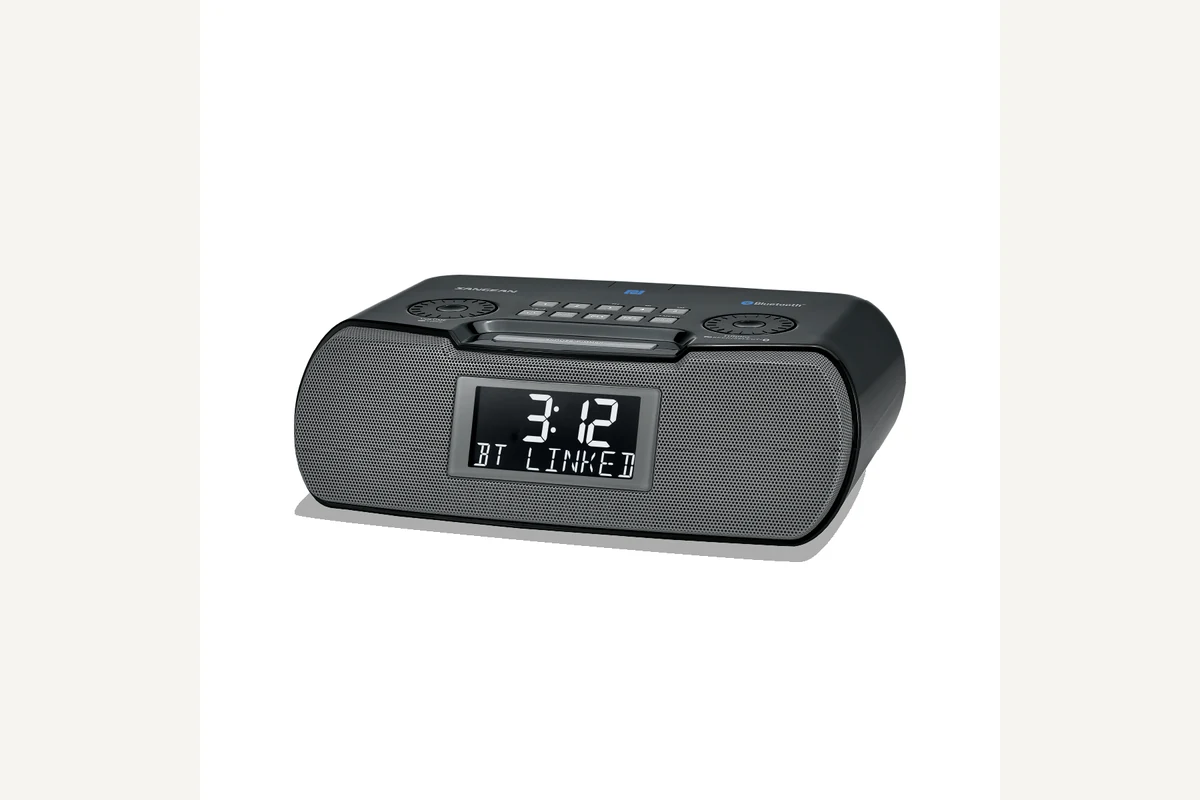
Sangean RCR-20
RCR-20 is the audio-first choice, closer to a compact radio system than a minimal clock with an FM checkbox.
The RCR-20 offers AM/FM-RDS, Bluetooth playback, aux input, an adjustable backlit display, USB charging, and two alarms. The cited US manual documents buzzer, AM, and FM wake sources.
Compare for a conventional dual-alarm clock radio
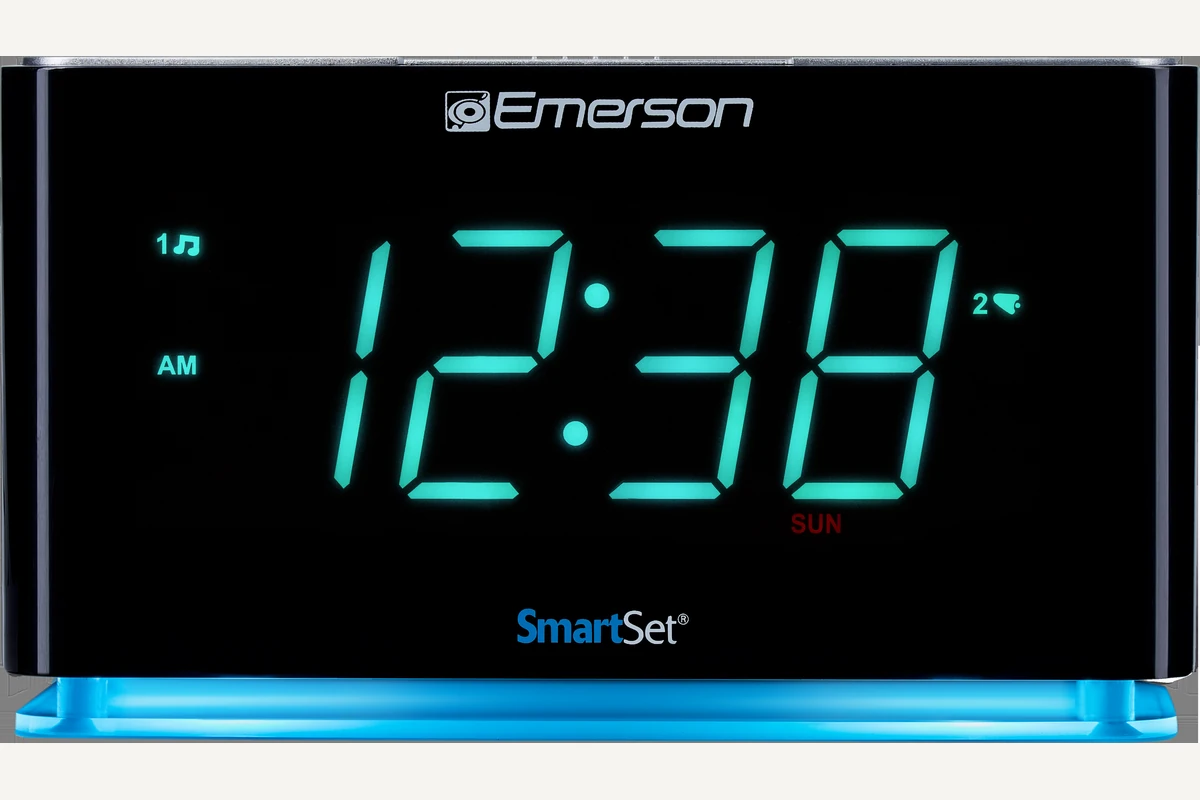
Emerson SmartSet ER100301
ER100301 is the conventional middle ground: dual schedules, radio or buzzer waking, Bluetooth, and simple USB charging.
This model combines FM radio, Bluetooth, dual alarms, weekday/weekend scheduling, a four-level dimmer, a night light, and a 2.1-amp USB charging port.
Compare for app-free sunrise, sunset, and FM radio
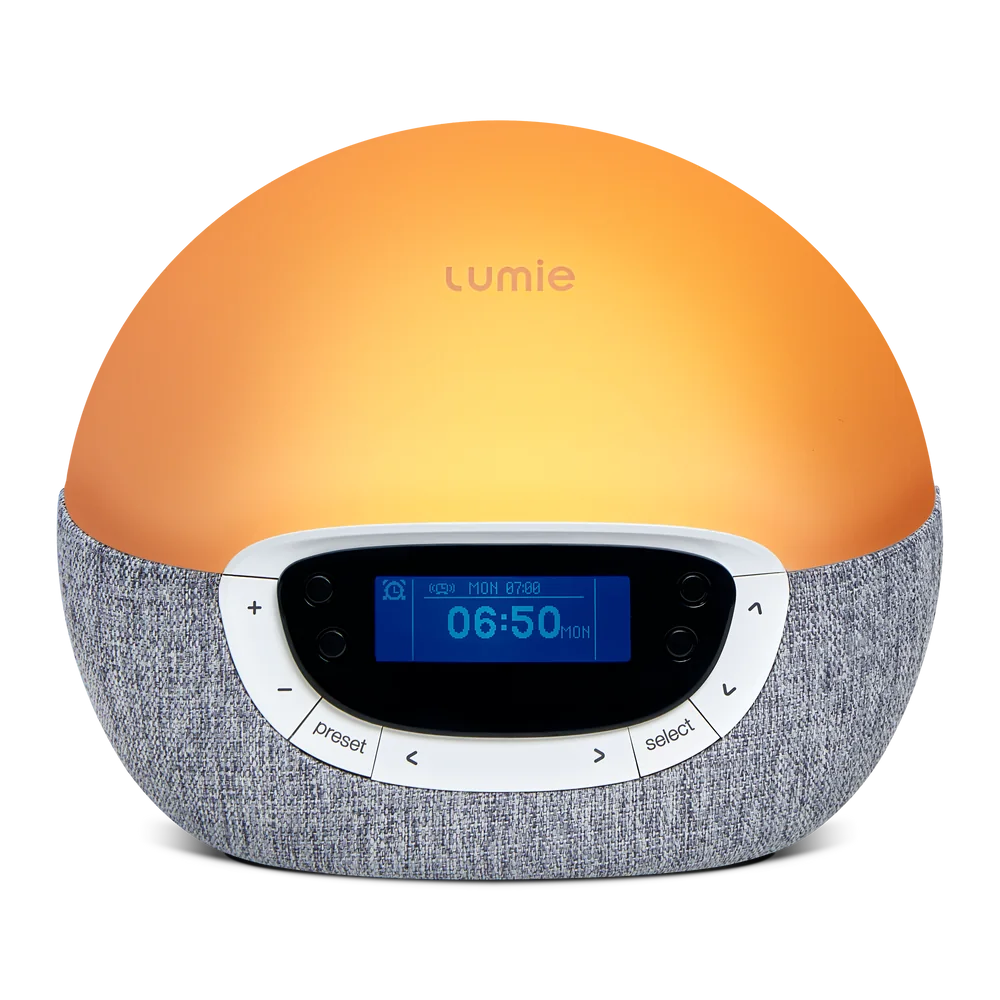
Lumie Bodyclock Shine 300
Shine 300 adds sunrise and sunset light to the radio route while keeping all setup on the device.
Shine 300 offers adjustable 15-to-90-minute sunrise and sunset routines, wake sounds, FM radio, a dimmable bedside light, and weekly alarm scheduling through physical controls.
Evidence trail