Commercial depth
Travel Alarm Clocks: Compact, Independent, and Easy to Reset
A travel alarm earns its space when it remains easy to set in an unfamiliar room and does not depend on the phone you are trying to put away.
The decision first
Will it still be easy to set in an unfamiliar room?
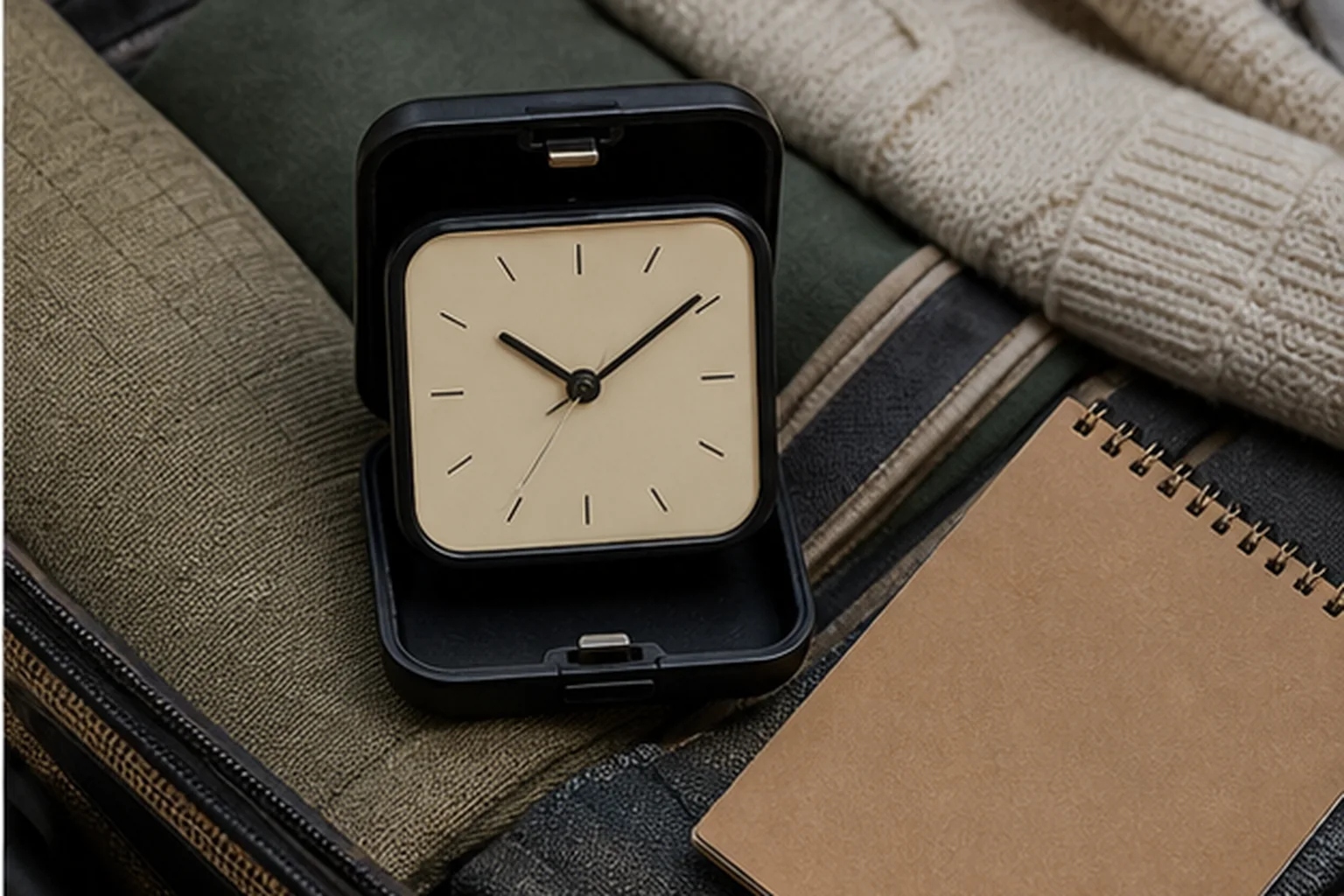
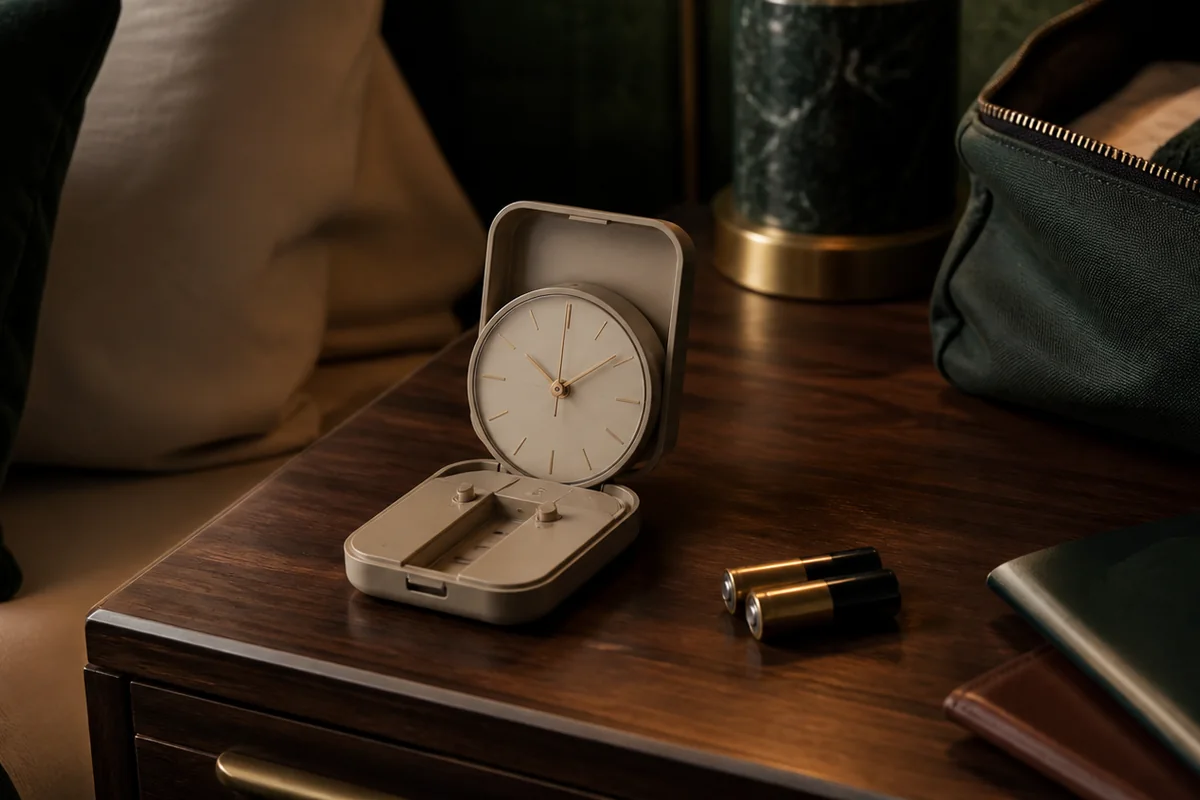
A travel alarm earns space in the bag when battery independence and a dedicated control path matter more than a large display or connected routine. A folding cover should protect the controls, the backlight should be brief, and time changes should not risk disabling the alarm.
Nonnegotiable checks
The criteria that can change the answer
Packed form
Measure the closed size and check whether buttons are protected.
Power
Use a battery type that is easy to carry or replace.
Reset speed
Changing time zones should not require rebuilding every alarm.
Hotel-room fit
The signal and backlight must work from an unfamiliar bedside position.
What changes in practice
Compare the trade-offs, not the feature count
| Route | Decision value |
|---|---|
| Dedicated clock | Reduces phone dependence, but adds one item to pack. |
| Folding case | Protects the display, with hinges and latches to inspect. |
| Button light | Keeps the room dark, but requires a press to read. |
| Continuous display | Instant reading, with more battery and light demand. |
Simulate the trip
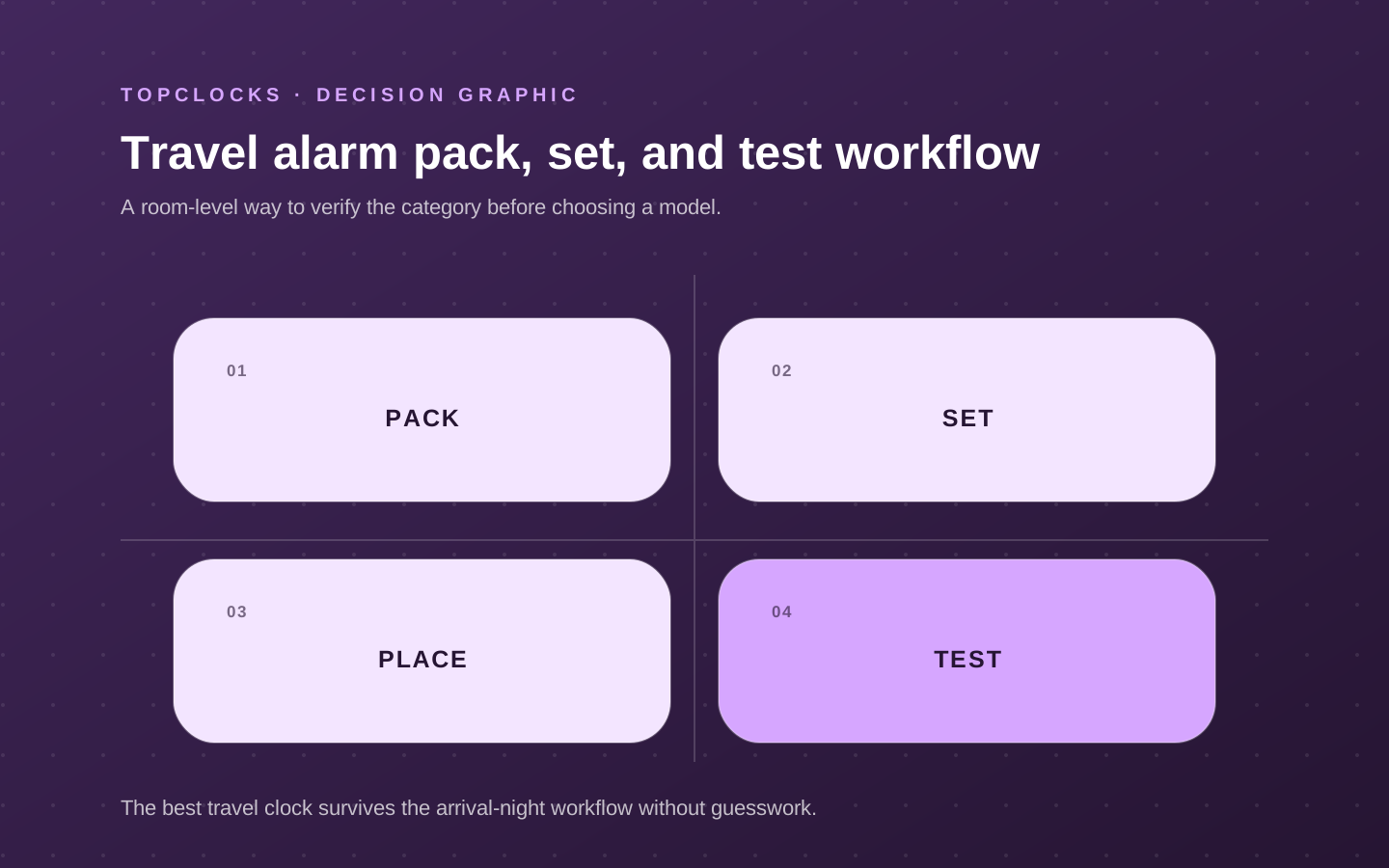
A travel alarm must survive the pack, set, place, and test sequence
Compact dimensions do not prove travel usability. The real test begins after a late arrival: find the clock, supply power, change the time, choose 12- or 24-hour mode if needed, set the alarm, verify it is active, place it in an unfamiliar room, and run a short test without disturbing others. A model that is tiny but cryptic can create more risk than a slightly larger clock with direct controls.
Practice the sequence at home twice without the manual. Check whether time and alarm controls can be confused, whether a folding cover protects or hides them, and whether a lock prevents accidental changes in a bag. For analog clocks, learn the approximate alarm-hand window and twelve-hour cycle. For digital clocks, check AM/PM, day patterns, DST, and button combinations. For projection, add stand position, focus, orientation, and required power.
Placement changes in every room. The clock may sit on a low desk, across the room, beside a hotel phone, or near an unavailable outlet. Test audibility and display angle from bed. Keep the route to a distant shutoff point safe in darkness. A phone can remain a useful second path, but the dedicated travel clock should not share the same unverified charging adapter if independence is the reason for carrying it.
- Pack every required battery, cable, and adapter as part of the clock system.
- Change time and set the alarm without relying on familiar room lighting.
- Run a short arrival-night test and confirm the active state afterward.
- Place the device where the signal reaches the sleeper and the controls cannot be bumped accidentally.
Choose destination power
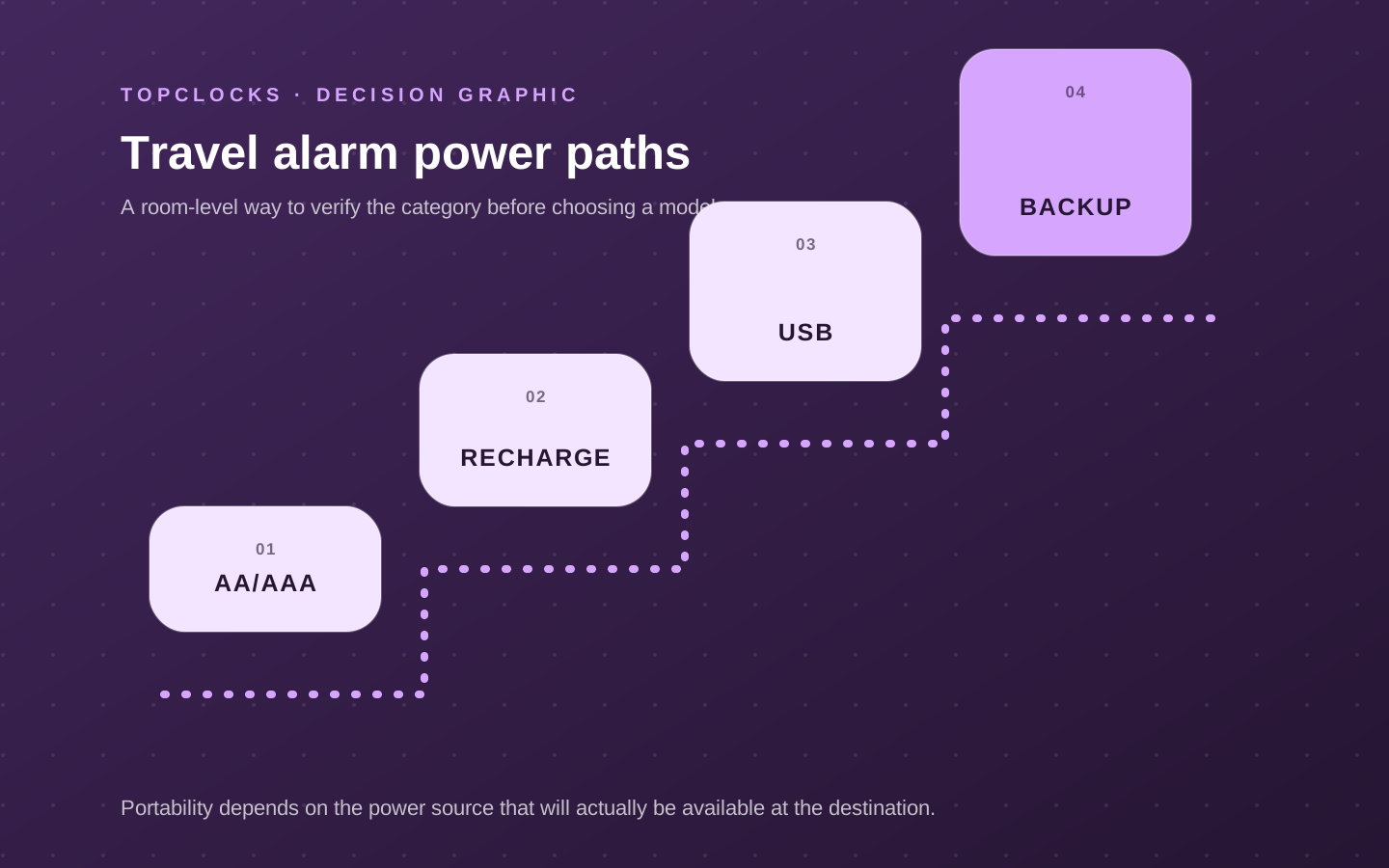
Replaceable batteries, rechargeable cells, and USB power fail differently
A replaceable-battery alarm provides complete outlet independence when the battery powers normal operation.
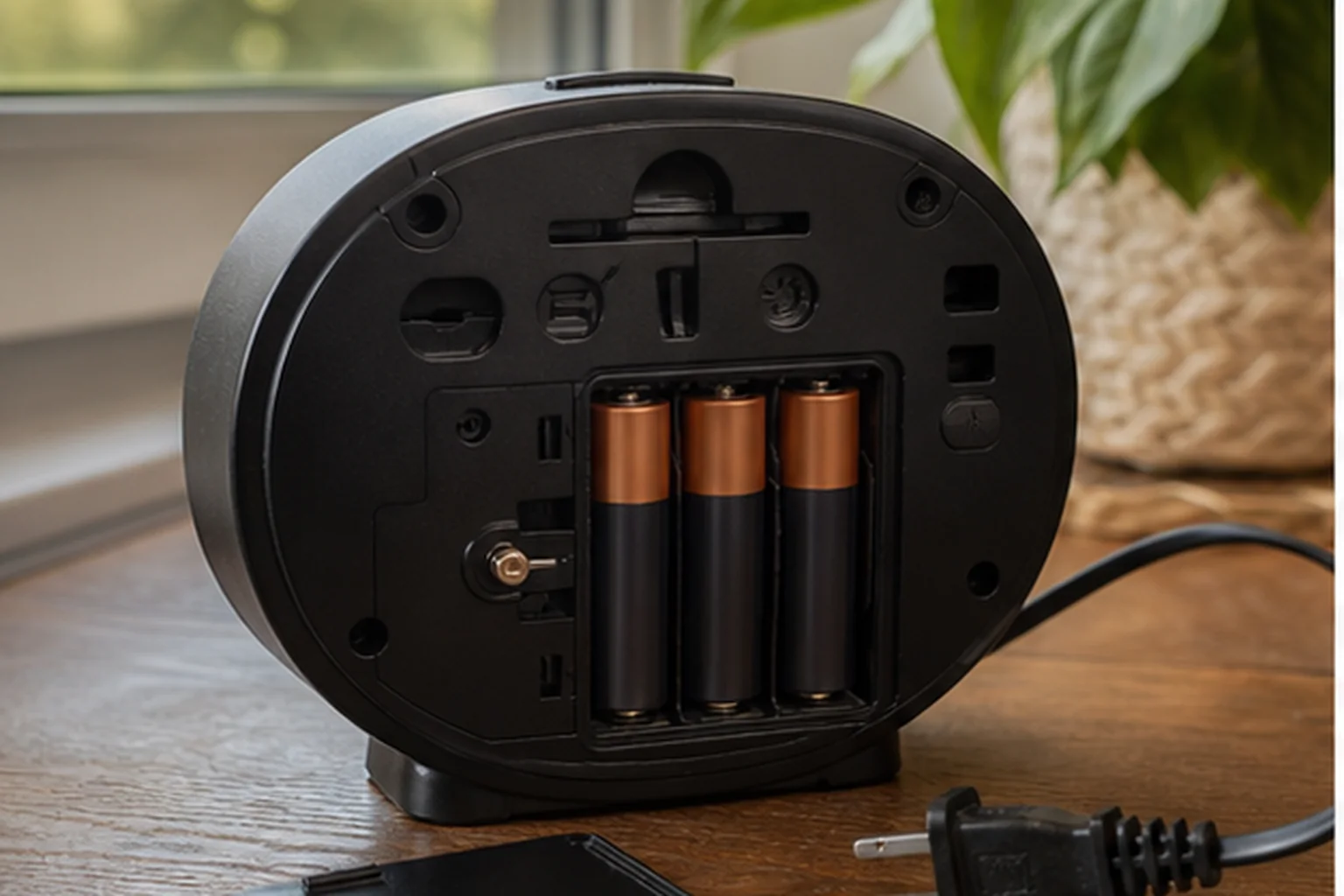
Common cells can be easy to carry and replace, while availability and airline or storage rules still deserve planning. A rechargeable device avoids spare disposable cells and can become another item that must be charged. A USB-powered clock may fit modern travel kits but depends on a compatible adapter, cable, outlet, and voltage handling described by the manufacturer.
Do not confuse a memory battery with portable operation. A projection or radio clock can include backup cells that retain time while requiring USB or mains for the display, projector, radio, or alarm. Read what the battery actually powers. If the clock’s main purpose is to provide a backup independent of the phone, place it on a different power path or choose full battery operation.
Record battery installation date and check the compartment before travel. Remove or handle cells according to the manual during long storage. For rechargeable devices, verify the battery indicator and test the alarm with a realistic charge margin. For USB models, label the clock input and any phone-charging output so the wrong port or underpowered adapter does not become an arrival-night surprise.
- Replaceable battery: best for outlet independence, with battery maintenance and spare-cell planning.
- Rechargeable: useful for repeated travel, with charge state and long-storage care.
- USB powered: flexible when the required adapter and cable are always packed.
- Memory backup: valuable for settings, but not proof of full alarm operation away from mains.
Respect the temporary room
Hotels, shared rooms, and time zones change the acceptable signal
A travel alarm often operates closer to other people than a home clock. Hotel walls, roommates, children, or a partner can make a high-output sound inappropriate. A vibration alarm may localize the cue and still buzz against a hard nightstand or transmit through a shared bed. Projection may help read time without touching a phone and introduce ceiling light. Choose the signal after naming who shares the room.
Time-zone changes create a setting risk. A simple analog clock requires manual adjustment and makes the twelve-hour cycle the user’s responsibility. A digital clock may offer easy plus/minus controls or hide time changes in a menu. A phone normally updates automatically and can be wrong when network or time-zone settings are unexpected. A radio-controlled clock may not receive its home signal at the destination. Always verify displayed local time and the scheduled alarm as separate facts.
Noise policies and unfamiliar safety routes also affect placement.
Do not place a moving alarm where it can fall into a walkway. Avoid stretching cables across the room to reach the bed. If the clock must be across the room to require standing, identify a clear path and low-level light that does not interfere with sleep. Keep important travel documents and the alarm controls distinct so the morning action is deliberate.
- Confirm local time manually even when automatic adjustment is expected.
- Test sound, vibration noise, and projection spillover with room companions in mind.
- Use a clear, safe route when placement requires leaving the bed.
- Keep a separate backup for flights and other fixed departures.
Compare two honest routes
Choose compact battery simplicity or feature-rich powered travel use
A Braun BC02-style analog route offers one AA battery, small dimensions, no account, and physical controls, with approximate alarm setting and no snooze as the visible trade-offs. A folding La Crosse projection route offers ceiling readability, digital setting, and charging, with USB-C power and projector setup as the trade-offs. A compact battery digital or vibration clock may be the relevant third route when exact time or a local cue is nonnegotiable.
Compare dimensions only after the power and control paths pass. Record weight and folded size, but also battery or adapter, display at night, alarm source and volume, active indicator, lock, snooze, time-zone workflow, and behavior after power interruption. Verify every model-specific fact at the official source. Retailer labels such as “travel” do not prove a protective case, control lock, or outlet independence.
Conduct a packing test with the actual bag. Confirm that pressure cannot arm, disarm, or reset the clock. Unpack in a darkened unfamiliar room at home, change time, set two test alarms, and place the device at a realistic distance. For USB power, test the exact travel adapter. For batteries, use known-good cells and carry spares where appropriate.
- Reject a model that cannot be set and verified quickly after arrival.
- Reject a power path that conflicts with the destination or the reason for carrying a backup.
- Reject a signal that is unreliable or disruptive in a shared room.
- Prefer controls and indicators that remain obvious when tired, offline, and away from home.
The strongest travel alarm is not the smallest object. It is the device whose complete setup can be reproduced in a new room with fewer unverified assumptions.
Verify in the room
Pack, reset, and verify the clock in an unfamiliar room
A travel alarm earns its place by remaining understandable after a late arrival, a time change, and an unfamiliar bedside layout. Small size alone does not protect the morning. Treat this as a selection experiment for travel alarm clocks, not a claim that one model will work for every sleeper. The objective is to expose a mismatch while the clock can still be returned, moved, or reconfigured.
Pack the clock with its normal case, cable, adapter, or spare battery.
Unpack it in a different room, change the time, set the alarm, and place it where the display and sound can work without the home nightstand. Keep the first run deliberately ordinary. Extreme settings can hide a placement problem, and a special one-night routine does not show whether the setup is maintainable on workdays, school days, weekends, and schedule changes.
Travel alarms fail when controls are exposed in a bag, a time zone is set incorrectly, a proprietary cable is missing, the display is unreadable, or the alarm cannot be confirmed in the dark. Write the likely failure before running the test. That note prevents a bright display, attractive sound library, charging pad, or app from receiving credit for a wake path it cannot protect.
Record packed dimensions, travel lock or cover, power items required, setup steps, alarm indicator, sound reach, and whether settings survive the expected transit state. A simple dated log is enough. Avoid converting one successful morning into a universal result; repeat the check after changing bedding, furniture, power, software, room, or schedule because the signal path may have changed.
- Packed protection: write the observed state, not a yes-or-no impression. Add the condition that produced it and the next check if the result was unclear.
- Time-change process: write the observed state, not a yes-or-no impression. Add the condition that produced it and the next check if the result was unclear.
- Power kit: write the observed state, not a yes-or-no impression. Add the condition that produced it and the next check if the result was unclear.
- Dark-room controls: write the observed state, not a yes-or-no impression. Add the condition that produced it and the next check if the result was unclear.
- Alarm indicator: write the observed state, not a yes-or-no impression. Add the condition that produced it and the next check if the result was unclear.
- Unfamiliar placement: write the observed state, not a yes-or-no impression. Add the condition that produced it and the next check if the result was unclear.
A travel alarm passes when it can be packed, changed, armed, and checked twice without relying on a familiar room or phone connection. Reject a compact model when its controls, power kit, or confirmation sequence become less dependable after packing. If the result is mixed, do not average it into a score. Preserve the unresolved condition and compare only models that give you a direct way to verify it.
When reading product pages for travel alarm clocks, translate each promising label back into an observable state. “Reliable” should identify the cue that survives the expected power and dependency conditions. “Easy to use” should identify who sets the alarm, in what light, and how the active state is confirmed. “Best” should disappear unless the scenario and disqualifiers are stated beside it.
Close the hidden gaps
Questions that settle a choice about travel alarm clocks
For travel alarm clocks, these questions close the gaps left by retailer filters and broad “best alarm” lists. Each answer is a boundary for the shortlist, not a promise about an untested model.
What should be tested before buying travel alarm clocks?
Pack the clock with its normal case, cable, adapter, or spare battery. Unpack it in a different room, change the time, set the alarm, and place it where the display and sound can work without the home nightstand. Use the exact device revision and current manual when a control, accessory, app, or backup behavior affects the result.
Which failure should be ruled out first?
Travel alarms fail when controls are exposed in a bag, a time zone is set incorrectly, a proprietary cable is missing, the display is unreadable, or the alarm cannot be confirmed in the dark. Test that failure first, while the consequences are low, instead of increasing every setting at once.
How many checks make the result dependable?
Within this review of travel alarm clocks, one successful check confirms that the setup can work; it does not show that it is robust. Repeat it on ordinary mornings and after any change that affects the signal, power, placement, schedule, or stop action. High-consequence mornings deserve an independently tested backup.
Can specifications settle the choice?
Specifications and manuals can narrow the shortlist for travel alarm clocks by establishing intended controls, compatibility, power requirements, and operating states. They cannot establish what one sleeper will hear, see, or feel through a particular room and bed. Keep documented facts and room observations separate.
When should a candidate for travel alarm clocks leave the shortlist?
Reject a compact model when its controls, power kit, or confirmation sequence become less dependable after packing. A disqualifier should remove the model before price, design, reviews, or optional content are compared.
What does a passing result look like?
A travel alarm passes when it can be packed, changed, armed, and checked twice without relying on a familiar room or phone connection. The result should be visible in the log and repeatable without a special workaround that the household is unlikely to maintain.
Finish the decision about travel alarm clocks by writing one sentence: “This setup should wake this person, in this room, through this signal, under these power conditions, and it will be checked this way.” If any blank remains, the page has identified the next research task rather than pretending the purchase is settled.
Before relying on it
Run the complete alarm path
A product page can confirm features. Only a real setup check confirms that the selected signal, placement, controls, and power path work together in the room.
- Pack it in the intended bag.
- Change the time twice.
- Set an alarm without room lights.
- Carry a known-good spare battery.
Role-based product shortlist
Models worth comparing for this decision
These are desk-researched candidates, not a claim that one clock wins for everyone. Each card explains the scenario it fits, the limitation to verify, and the primary source used for the factual details.
Compare for compact, app-free travel use
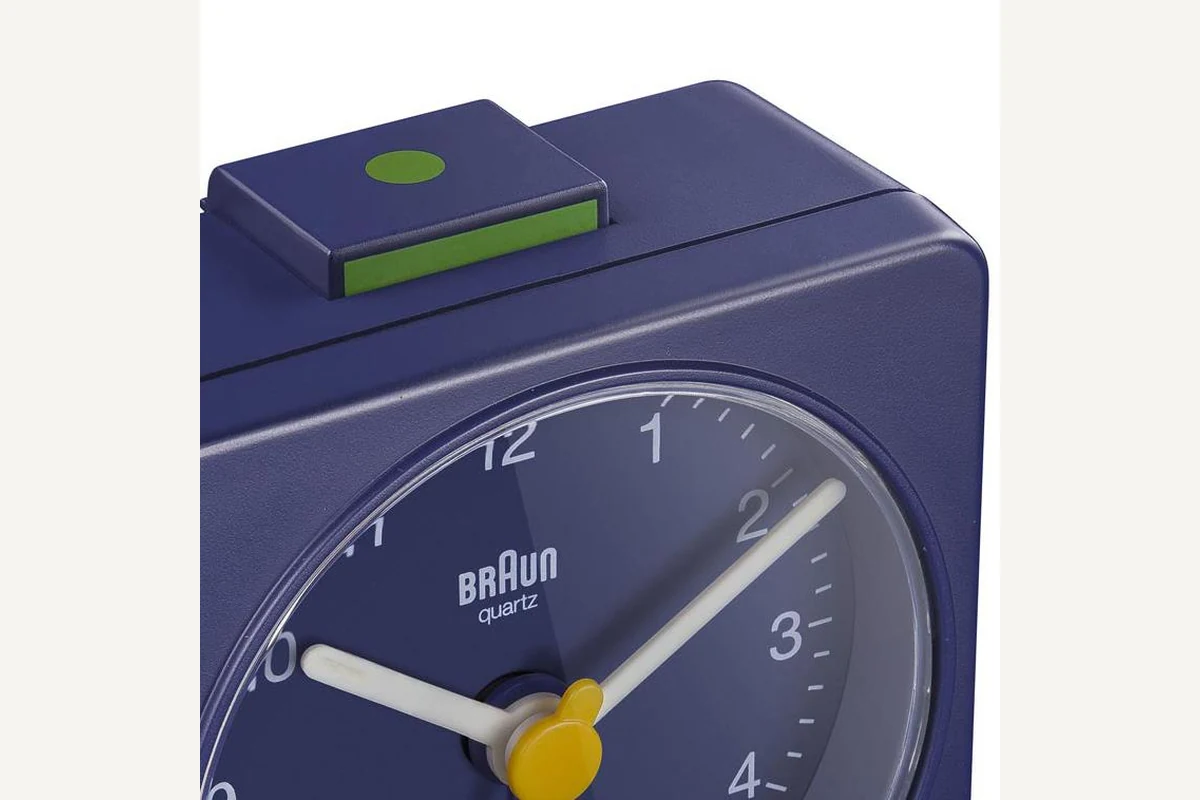
Braun BC02
BC02 is the packable, outlet-free reference, provided the traveler is comfortable setting a small analog alarm hand.
BC02 is a 57 mm square analog clock powered by one AA battery. It uses a quiet quartz tick movement, luminous-tipped hands, and a crescendo beep without an app, account, or wall outlet.
Compare for a foldable two-AAA travel clock
MeesMeek Digital Travel Alarm Clock
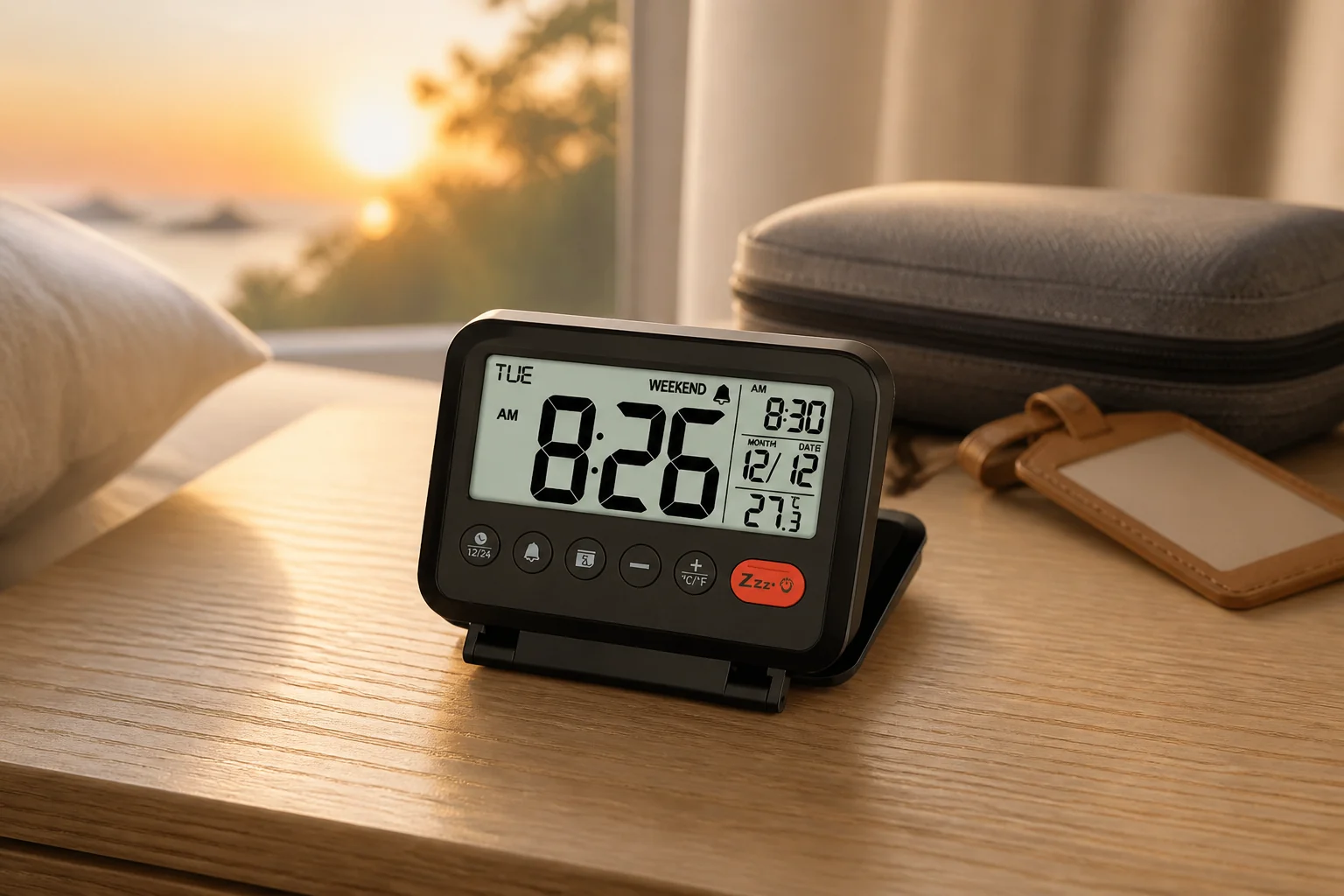
MeesMeek is the folding digital route, using two AAA cells and weekday-only recurrence while limiting its backlight to five seconds.
MeesMeek combines a folding four-inch body, passive 3.54-inch LCD, two AAA batteries, weekday-only alarm mode, two listed volume levels, nine-minute snooze, and a five-second backlight.
Compare for large cordless LED digits
Acedeck Battery-Operated Alarm Clock
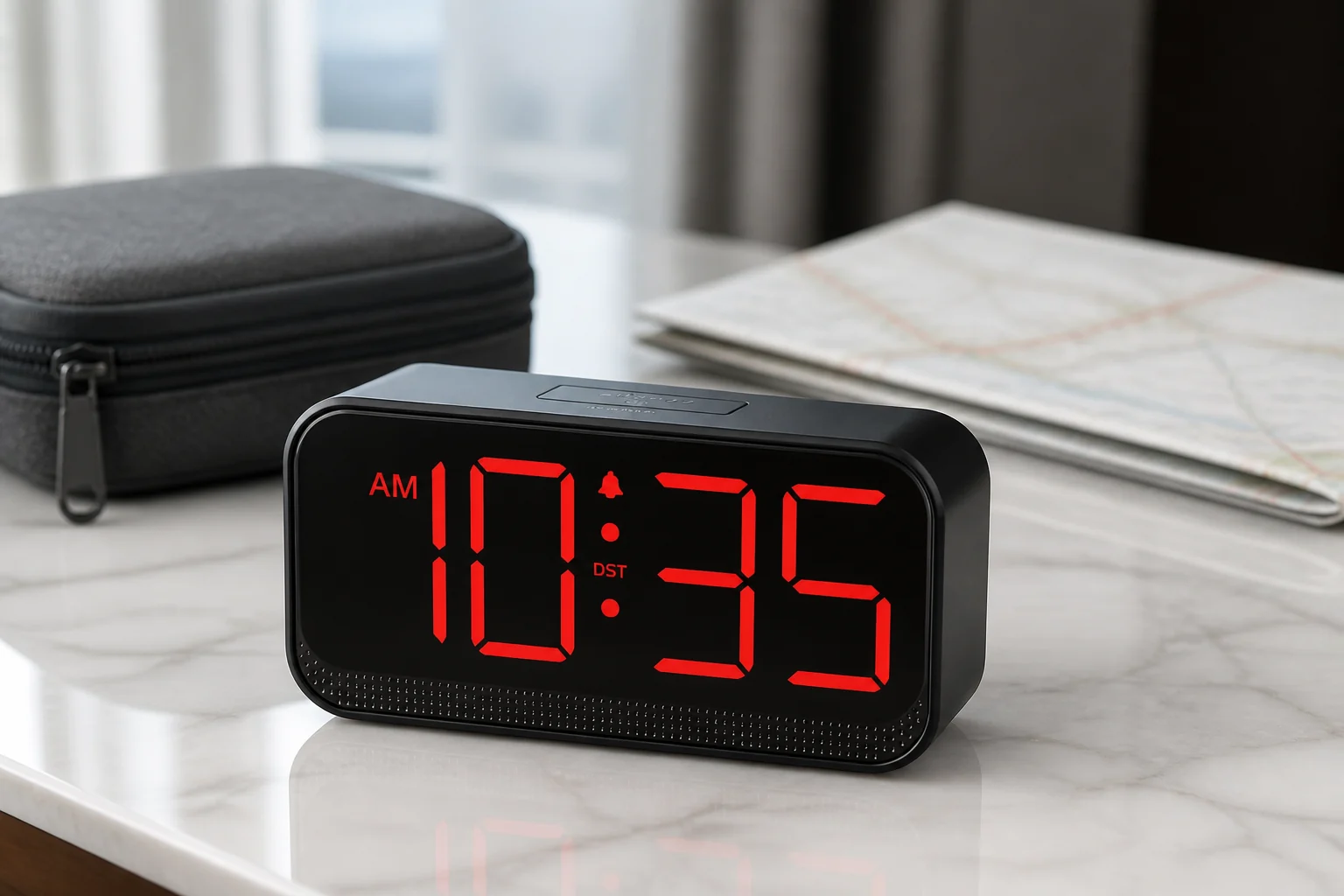
Acedeck trades a larger four-AA body for continuously visible cordless LED digits and a full display-off choice.
Acedeck uses four AA alkaline cells to run its large red LED display and audible alarm away from an outlet. It also accepts USB-C power and offers automatic dimming, three manual levels, display-off, and three alarm-volume choices.
Evidence trail