Core comparison
Loud Alarm vs Bed Shaker: Room-Wide Sound or Local Vibration?
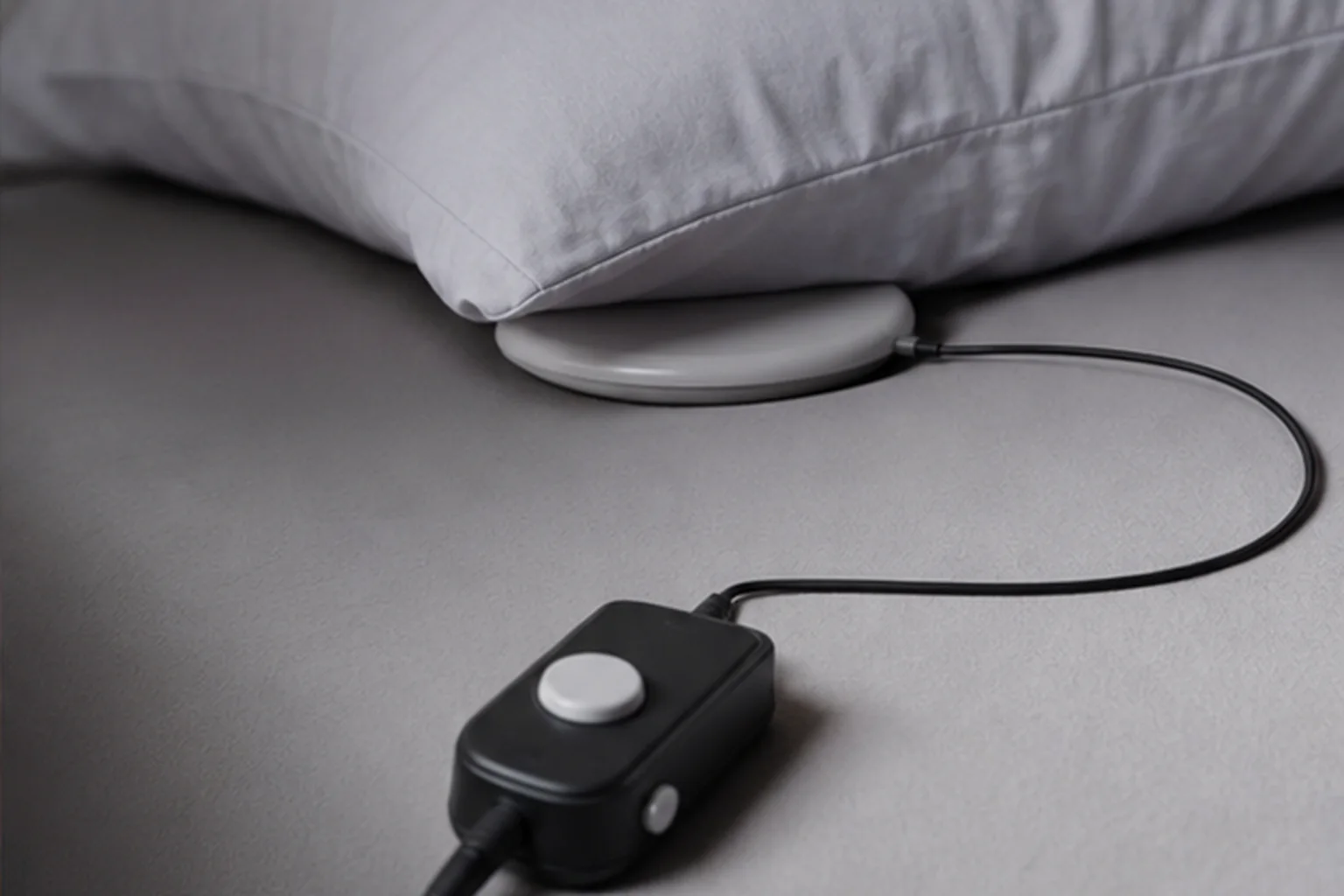
The recommendation splits at the delivery channel. Sound fills the room; a shaker transfers a physical cue through the bed or pillow.
The decision first
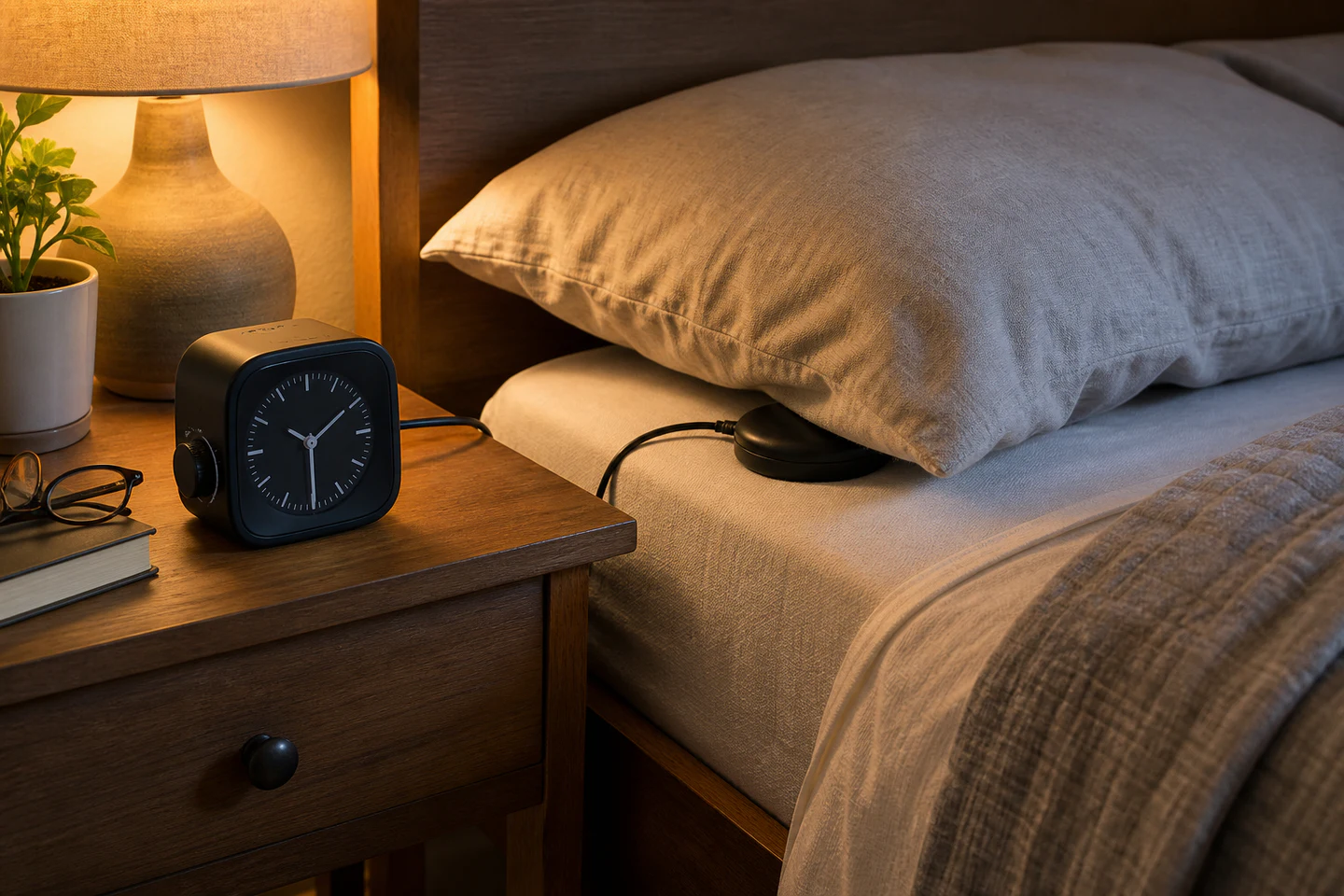
Should the alert fill the room or stay in the bed?
Choose a loud alarm when sound is accessible and waking the room is acceptable. Choose a bed shaker when vibration is the preferred or more local signal. For repeat misses or accessibility needs, a combined system can provide sensory-channel redundancy if both channels are configured and tested, but shared controls, schedule, and power can still fail together.

Side-by-side decision
Loud alarm vs bed shaker: the decisive differences
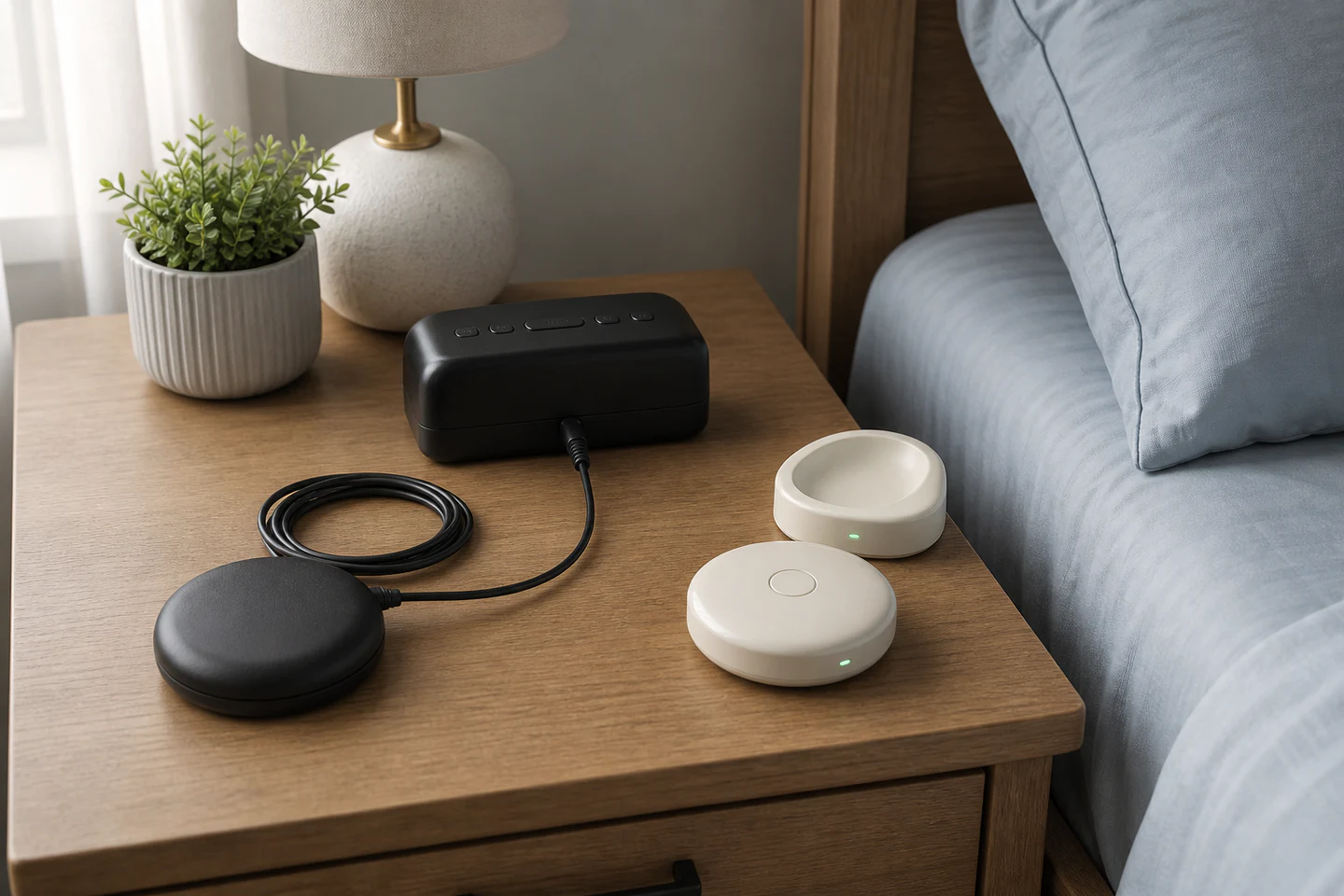
The useful split is how the signal reaches the intended sleeper and who else receives it. A combined system adds sensory-channel redundancy, but it remains one failure domain when both cues share the same clock, schedule, controls, or power.
-
Loud sound
Best when sound is accessible and a room-wide signal will not create an unacceptable household disturbance.
-
Bed shaker
Best when a tested tactile cue is accessible and can remain at a stable contact point through the night.
-
Sound + shaker
Best when two sensory channels improve access and the shared clock, schedule, controls, and power are understood.
| Decision criterion | Loud sound | Bed shaker | Sound + shaker |
|---|---|---|---|
| Signal path | Audible field through the room. | Tactile transfer through the pillow, mattress, or frame. | Both audible and tactile paths. |
| Accessible receiver | Only if the intended sleeper can hear the selected tone and volume. | Only if the sleeper can feel vibration at the tested contact point. | Each channel must be accessible; an extra channel does not guarantee a wake-up. |
| Room or partner impact | Can spread through the room and walls. | Reduces speaker noise, but motor or mattress transfer may still disturb a partner. | Creates both audible and physical spillover. |
| Check before sleep | Confirm alarm state, sound mode, tone, volume, and speaker path. | Confirm position, connector or charge, silent mode, and contact through the real bedding. | Test each channel alone, then together, and confirm the armed mode. |
| Primary failure | Inaccessible tone, blocked speaker, or unacceptable room disturbance. | A moved, damped, disconnected, or depleted shaker. | A shared clock, schedule, or control can remove both signals. |
| Power and backup | Verify the exact mains and battery behavior. | A wired shaker shares clock power; a wireless shaker needs charge and documented disconnected behavior. | Provides sensory-channel redundancy, not independent backup, when clock, schedule, mains, or controls are shared. |
| Reject this route | Reject when sound is inaccessible or spillover is unacceptable. | Reject when the contact point cannot be stable or silent mode is unavailable. | Reject when the added complexity creates another failure without covering a different one. |
Nonnegotiable checks
The criteria that can change the answer
Signal access
Do not assume louder sound is accessible to every sleeper.
Locality
Vibration can reduce room-wide noise when placed correctly.
Placement
A shaker can move or be damped; a loud clock can be blocked or silenced.
Backup
Two sensory channels can cover different reception failures, but they are not independent when they share the same clock, schedule, control, or power.
Compare physical reach
Sound fills the room; a shaker transfers a local physical cue
The decisive difference is not which product feels more extreme. A loud alarm creates an audible field that can reach the intended sleeper, partner, household, and neighboring rooms. A bed shaker transfers movement through a pillow, mattress, or frame near the sleeper. Choose the channel the receiver can access and the room can accept. A person who cannot reliably hear the alarm should not be routed to louder sound by default.
Locality is relative. A shaker can reduce speaker noise and still buzz against furniture or move a shared mattress. Sound can be localized somewhat through lower volume and close placement, but it normally remains a room cue. Test both with the intended receiver and any partner present. Product claims about output or vibration strength do not replace the physical room and bed.
A combined system can use sound and vibration together. This diversifies delivery while the channels share a schedule, clock, mains, and stop control. It is useful when the sleeper can receive both and a single-channel miss is plausible. It is not fully independent backup hardware.
- Choose sound when auditory access is realistic and room-wide impact is acceptable.
- Choose vibration when tactile access or a more local cue is required.
- Choose combined delivery when both channels cover different perception failures.
- Add separate hardware when one clock remains an unacceptable single point of failure.
Compare failure surfaces
A missed tone and a displaced shaker require different checks
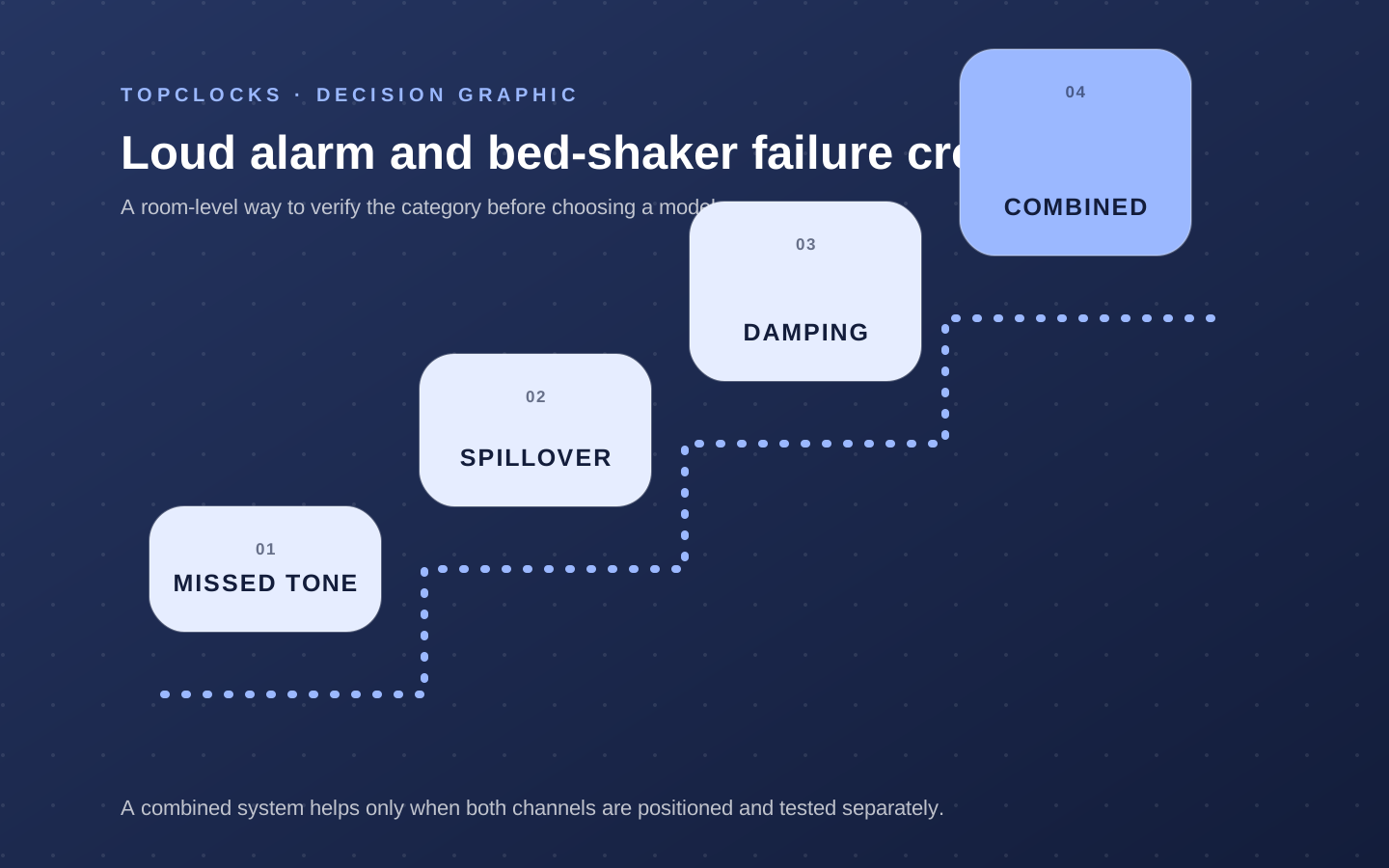
Sound can fail because the selected tone is inaccessible, volume is wrong, the speaker is covered, the clock is too distant, the alarm source was changed, or the user dismisses it automatically. A shaker can fail because it moved, disconnected, lost charge, was placed incorrectly, or was damped by bedding. A wearable can lose contact or be removed. These failures should appear beside the route, not buried after product recommendations.
Controls and power can affect both. A loud clock and wired shaker on one unit may use a mode switch that enables sound, vibration, or both. Verify the intended mode and its persistence after power interruption. A portable shaker may store alarms locally after app setup; confirm disconnected operation and charge. Backup batteries may retain settings without running either output.
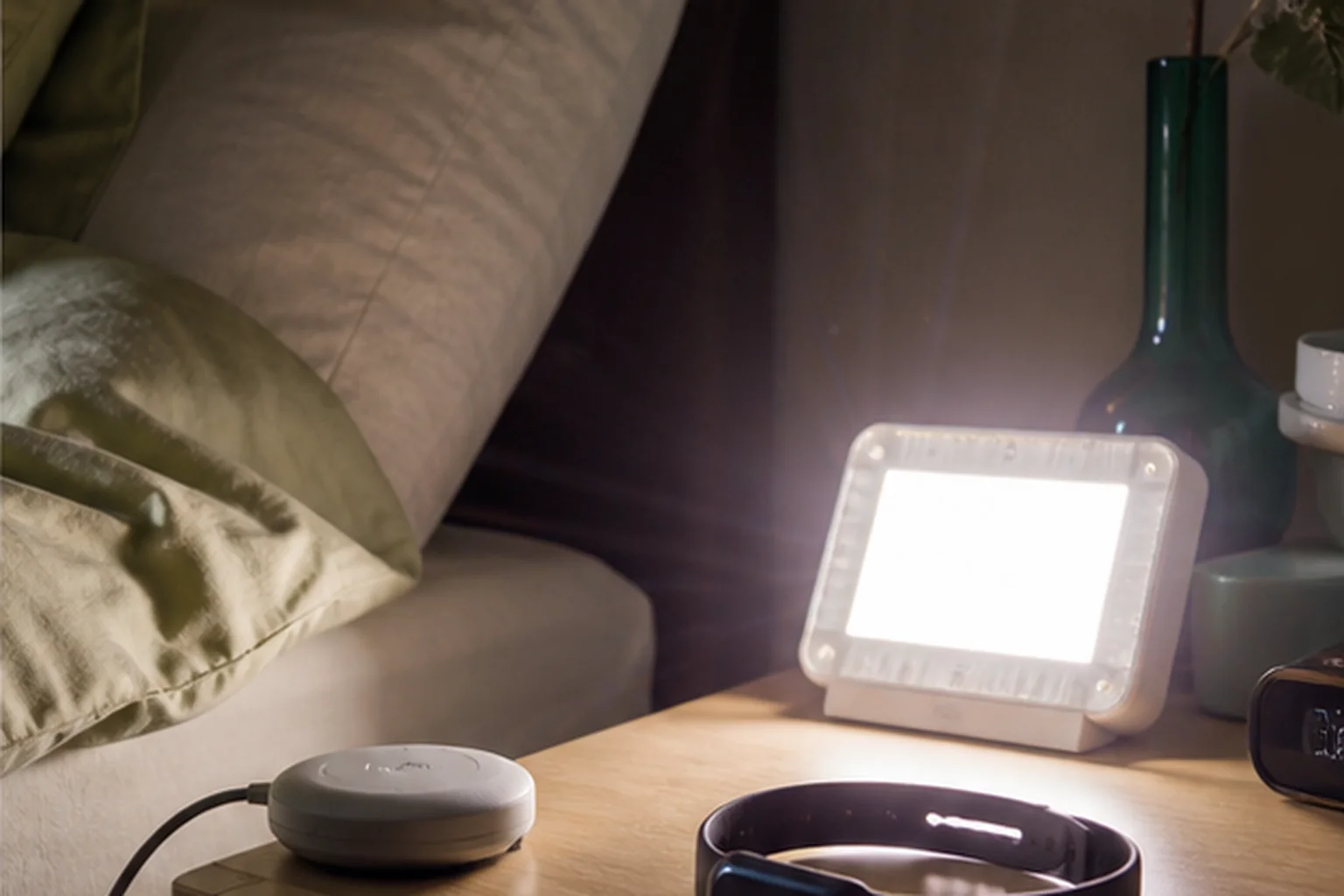
Choose the failure that is easier to prevent and monitor in the user’s routine. A cable can be inspected nightly. A battery indicator can be checked. A speaker can be placed correctly. A partner can report spillover. When neither route is acceptable alone, a different channel such as light or a separate wearable may be more useful than escalating both.
- Test sound and shaker alone before enabling combined mode.
- Inspect speaker position, shaker stability, connector, battery, and active mode.
- Confirm what the backup battery powers during a daytime outage test.
- Re-test after moving the clock or changing the mattress and bedding.
Apply the room constraint
Heavy sleepers, deaf users, couples, and travelers cross the boundary differently
A sound-accessible heavy sleeper may start with adjustable loudness and add a shaker after sound-only misses. A deaf sleeper may start with vibration and use flash or another non-audible channel for backup; sound may be optional. A couple may choose a shaker to limit audible spillover and discover that the mattress transfers movement. A traveler may prefer a battery pillow alarm over a wired system and accept a smaller contact area.
These scenarios should not be collapsed into one “best bed shaker” ranking. The same Sonic Bomb system can demonstrate both loud and tactile channels. A portable Vibio demonstrates rechargeable, app-configured vibration. A battery pillow alarm demonstrates outlet-free tactile use. The correct role depends on accessibility, locality, power, cable, and schedule requirements.
Intensity remains an adjustable means, not the page’s goal. Use the lowest reliable sound or vibration and check bystander impact. Avoid promising that a stated dB maximum or “strong” shaker wakes every sleeper. Persistent waking difficulty or daytime impairment remains outside a product comparison’s diagnostic scope.
- For heavy sleepers, identify whether the cue is missed or dismissed.
- For deaf users, verify the non-audible primary channel independently.
- For couples, test both motor noise and mattress transfer.
- For travel, compare full battery operation with cable and app requirements.
Prove the boundary
Compare Sonic Bomb and Vibio by channel, locality, and dependency—not one winner
Sonic Alert Sonic Bomb SBB500SS represents a fixed multi-channel route with adjustable high-output sound, flash, and an included wired shaker. Bellman Vibio represents a portable rechargeable tactile route configured by app and intended to remember alarms on the device. One provides integrated audible and tactile coverage; the other removes room sound and the fixed cable while adding charge and app compatibility.
Verify current official claims for modes, volume, included shaker, alarm storage, disconnected behavior, power, battery, controls, and placement. Do not compare manufacturer superlatives as if they came from one independent lab test. Use the product cards as source-linked candidates and keep hands-on outcome claims out unless they are actually supported.
Set both routes conservatively during the day. Test the sound field from the bed and outside the room. Test the shaker under the actual bedding and from the partner’s side. Confirm silent mode, stop, snooze, active state, and the next alarm. Test documented outage or disconnected behavior. Keep a separate backup for high-consequence mornings where one device is not enough.
- Reject loud sound when it is inaccessible or unacceptable to the room.
- Reject a shaker when placement, cable, charge, or transfer cannot be controlled.
- Reject combined mode when its shared power or controls leave the critical failure uncovered.
- Prefer the route whose physical signal and ongoing checks fit the user’s actual bed and household.
The comparison is resolved when the user can state whether the cue should occupy the room or remain in contact with the bed—and can verify that boundary in practice.
Verify in the room
Choose between room reach and bed-local delivery
A loud alarm sends sound through the room; a shaker sends movement through bedding or the body. The better route depends on sensory access, the bed, surrounding people, and which failure needs coverage.
Treat this as a selection experiment for loud alarm versus bed shaker, not a claim that one model will work for every sleeper. The objective is to expose a mismatch while the clock can still be returned, moved, or reconfigured.
Test sound at the pillow with doors and walls in their normal state. Test vibration in the exact mattress or wearable position. Include the partner or bystander response in both checks. Keep the first run deliberately ordinary. Extreme settings can hide a placement problem, and a special one-night routine does not show whether the setup is maintainable on workdays, school days, weekends, and schedule changes.
Sound fails through inaudibility, blockage, automatic dismissal, or unacceptable spillover. Vibration fails through damping, displacement, disconnection, lost charge, or shared-mattress transmission. Write the likely failure before running the test. That note prevents a bright display, attractive sound library, charging pad, or app from receiving credit for a wake path it cannot protect.
Record volume and tone, shaker intensity and placement, receiver response, bystander response, power path, stop action, and whether either cue moved overnight. A simple dated log is enough. Avoid converting one successful morning into a universal result; repeat the check after changing bedding, furniture, power, software, room, or schedule because the signal path may have changed.
- Auditory access: write the observed state, not a yes-or-no impression. Add the condition that produced it and the next check if the result was unclear.
- Tactile access: write the observed state, not a yes-or-no impression. Add the condition that produced it and the next check if the result was unclear.
- Room spillover: write the observed state, not a yes-or-no impression. Add the condition that produced it and the next check if the result was unclear.
- Mattress spillover: write the observed state, not a yes-or-no impression. Add the condition that produced it and the next check if the result was unclear.
- Placement stability: write the observed state, not a yes-or-no impression. Add the condition that produced it and the next check if the result was unclear.
- Different backup path: write the observed state, not a yes-or-no impression. Add the condition that produced it and the next check if the result was unclear.
The comparison passes when one route clearly reaches the sleeper with acceptable spillover, or when the two routes provide justified independent layers. Reject the assumption that a shaker is always private or that more decibels always create a more accessible alert. If the result is mixed, do not average it into a score. Preserve the unresolved condition and compare only models that give you a direct way to verify it.
If both cues appear viable, assign them different roles before combining them. Sound can serve as the room-level deadline while vibration provides a tactile primary or backup at the bed; the order can also be reversed when tactile access is more dependable.
Then test each route alone. A combined alarm can look redundant while both outputs still share one outlet, one control surface, and one device. Separate-device backup adds maintenance, but it can remove that shared point of failure. The consequence of a missed alarm should determine whether this extra independence is worth the added setup.
When reading product pages for loud alarm versus bed shaker, translate each promising label back into an observable state. “Reliable” should identify the cue that survives the expected power and dependency conditions. “Easy to use” should identify who sets the alarm, in what light, and how the active state is confirmed. “Best” should disappear unless the scenario and disqualifiers are stated beside it.
Close the hidden gaps
Questions that settle a choice about loud alarm versus bed shaker
For loud alarm versus bed shaker, these questions close the gaps left by retailer filters and broad “best alarm” lists. Each answer is a boundary for the shortlist, not a promise about an untested model.
What should be tested before buying loud alarm versus bed shaker?
Test sound at the pillow with doors and walls in their normal state. Test vibration in the exact mattress or wearable position. Include the partner or bystander response in both checks. Use the exact device revision and current manual when a control, accessory, app, or backup behavior affects the result.
Which failure should be ruled out first?
Sound fails through inaudibility, blockage, automatic dismissal, or unacceptable spillover. Vibration fails through damping, displacement, disconnection, lost charge, or shared-mattress transmission. Test that failure first, while the consequences are low, instead of increasing every setting at once.
How many checks make the result dependable?
Within this review of loud alarm versus bed shaker, one successful check confirms that the setup can work; it does not show that it is robust. Repeat it on ordinary mornings and after any change that affects the signal, power, placement, schedule, or stop action. High-consequence mornings deserve an independently tested backup.
Can specifications settle the choice?
Specifications and manuals can narrow the shortlist for loud alarm versus bed shaker by establishing intended controls, compatibility, power requirements, and operating states. They cannot establish what one sleeper will hear, see, or feel through a particular room and bed. Keep documented facts and room observations separate.
When should a candidate for loud alarm versus bed shaker leave the shortlist?
Reject the assumption that a shaker is always private or that more decibels always create a more accessible alert. A disqualifier should remove the model before price, design, reviews, or optional content are compared.
What does a passing result look like?
The comparison passes when one route clearly reaches the sleeper with acceptable spillover, or when the two routes provide justified independent layers. The result should be visible in the log and repeatable without a special workaround that the household is unlikely to maintain.
Finish the decision about loud alarm versus bed shaker by writing one sentence: “This setup should wake this person, in this room, through this signal, under these power conditions, and it will be checked this way.” If any blank remains, the page has identified the next research task rather than pretending the purchase is settled.
Before relying on it
Run the complete alarm path
A product page can confirm features. Only a real setup check confirms that the selected signal, placement, controls, and power path work together in the room.
- Test the chosen channel in the real bed.
- Confirm silent mode.
- Inspect cable reach or battery status.
- Keep a separate backup for critical mornings.
Role-based product shortlist
Models worth comparing for this decision
These are desk-researched candidates, not a claim that one clock wins for everyone. Each card explains the scenario it fits, the limitation to verify, and the primary source used for the factual details.
Compare for loud sound plus a bed shaker
Sonic Alert Sonic Bomb SBB500SS
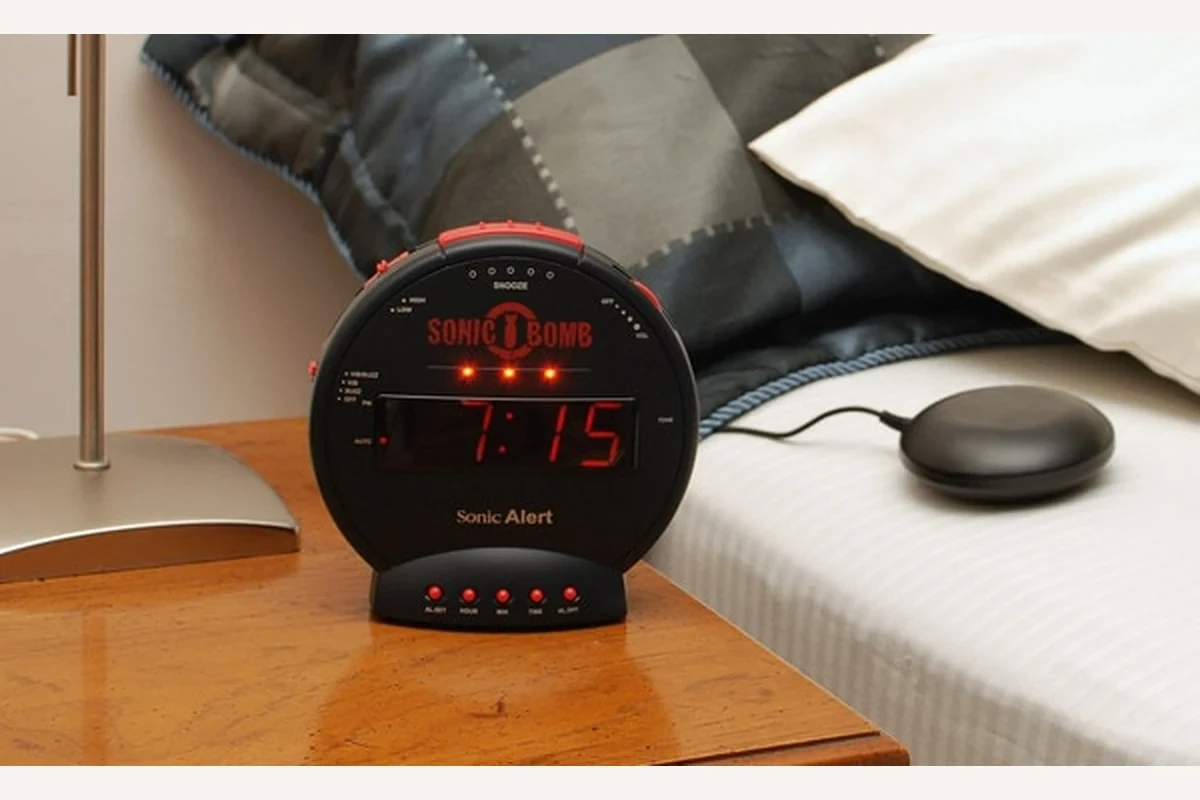
Sonic Bomb lets one device demonstrate both sides of the trade-off because its high-output alarm ships with a wired shaker.
The clock combines adjustable sound, flashing lights, dual alarms, and an included 12-volt bed shaker. The manufacturer lists a 113 dB maximum, so the useful question is how far below that maximum the sleeper can set it.
Compare for a portable silent alarm
Bellman Vibio BE1221
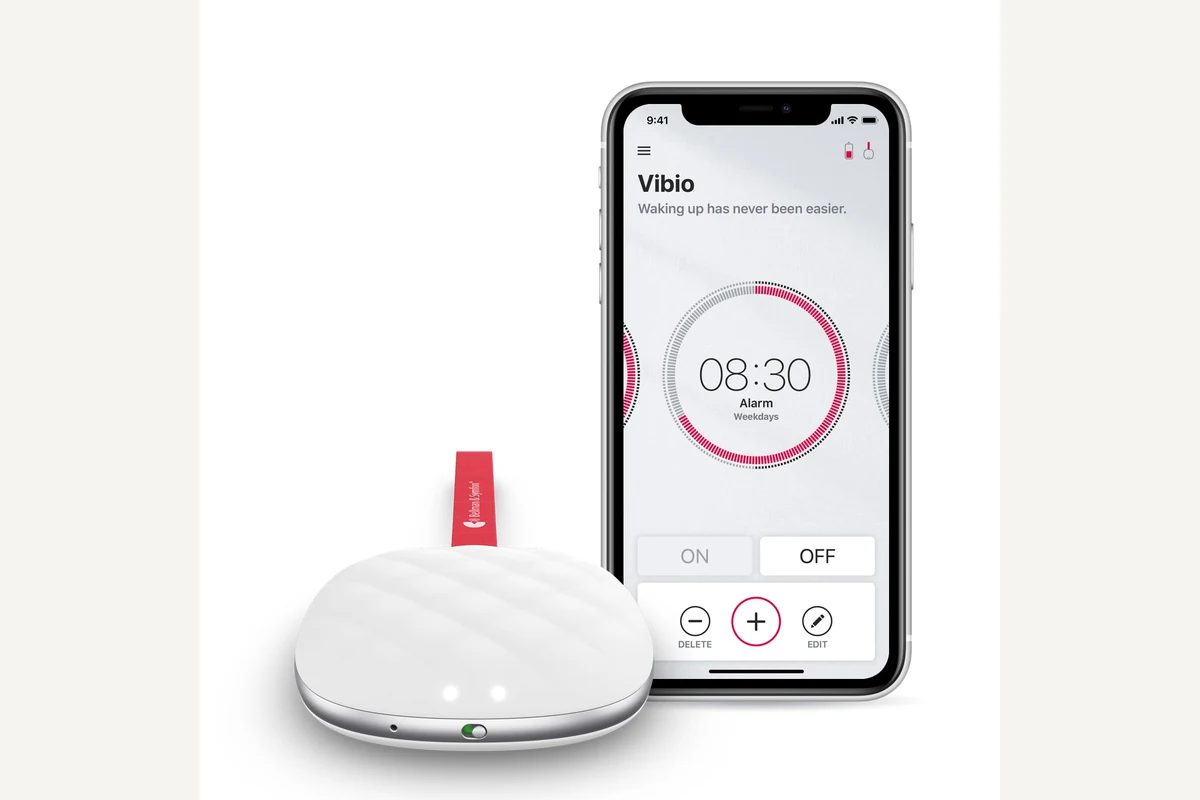
Vibio isolates the tactile route: adjustable vibration stays near the sleeper without turning up sound for the whole room.
Vibio is a rechargeable Bluetooth bed shaker with adjustable vibration. Alarms are created in the app, then remembered by the device, so the phone does not have to remain connected at wake time.
Evidence trail